DVB subtitles (DVBSub)
DVBSub carries broadcast subtitle services using timed page, region, object and colour-table segments in a transport stream.
DVB subtitles, often called DVBSub, are a broadcast subtitling system defined by ETSI EN 300 743. Their common graphical mode assembles subtitles from indexed-pixel objects, regions and a timed page composition.
The system can support character-code objects under local agreements as well. It should therefore be described as a graphics-oriented subtitle system with defined additional modes, rather than as proof that every possible DVB subtitle contains only bitmap runs.
Transport identity and subtitle-service identity
DVB subtitle data travels in PES packets within an MPEG transport stream. The PES timing supplies presentation timestamps. Transport packets use a PID to identify the carrying stream.
A single such stream can carry more than one subtitle service. Signaling identifies the intended language/type and the composition page ID, with an ancillary page ID when applicable. The PID alone can therefore be insufficient to choose the desired caption service.
An Emby recording retaining the broadcast transport can preserve those relationships. When a tool extracts or repackages a subtitle track, it must keep the service configuration needed to interpret its data.
A page is built from regions and objects
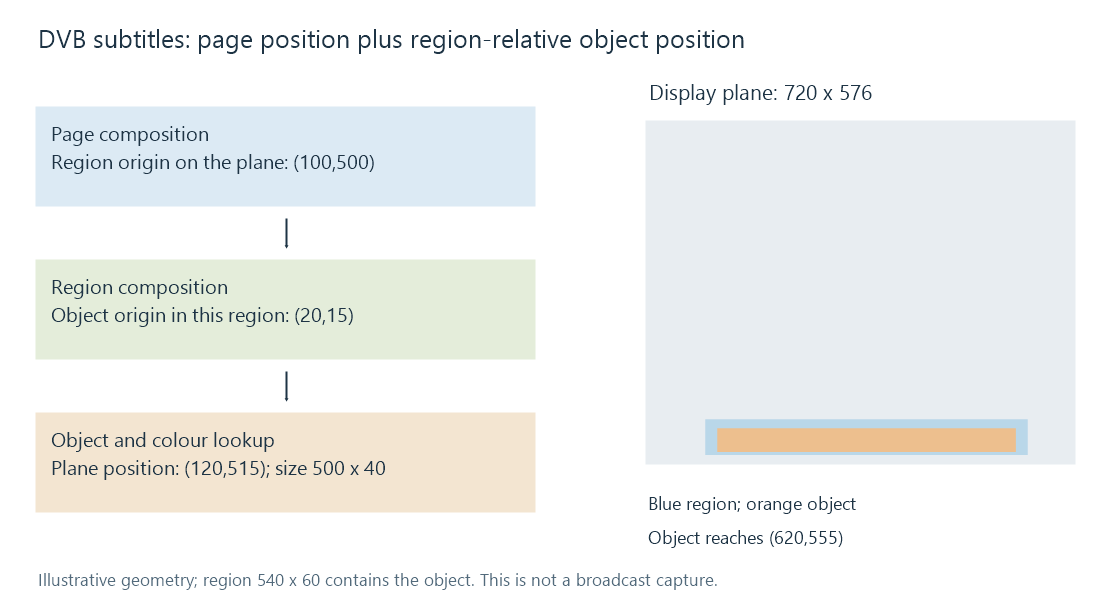
The roles form a hierarchy:
| Role | Purpose |
|---|---|
| Page composition | Selects regions, their positions and page state |
| Region composition | Defines region dimensions, depth, colour-table identity and placed objects |
| Object data | Supplies graphical content or the applicable alternative coding |
| Colour lookup table, CLUT | Resolves indexed values to colour/transparency |
| Display definition | Establishes display geometry where provided |
Objects can be updated without replacing the whole page. Regions can move or become visible through a page update. The stored data is therefore a sequence of state changes, not necessarily a collection of independent screenshots.
Adding the two levels of position
Suppose a region begins at (100,500) on a 720 × 576 display plane. An object begins at (20,15) within that region. Its plane position is:
x = 100 + 20 = 120
y = 500 + 15 = 515
For a 500 × 40 object, its extent reaches x = 620 and y = 555, within this illustrative plane. The region must also be large enough to contain the object. Confusing the region-relative position with the page-relative position would put the graphic in another location.
The CLUT and pixel-depth interpretation complete the picture. A valid object run decoded with the wrong colour-table state is not the intended subtitle.
Tuning and seeking require an acquisition state
An update in the middle of a service may assume that earlier objects or regions are already known. A live receiver tuning into that stream needs an acquisition point containing the information required for the next page. A recording seek has a comparable need to reconstruct state.
The page composition also supplies a timeout in seconds. If the page is not replaced or redefined, it eventually ceases to be valid and should be erased. This prevents a stale caption from remaining indefinitely after a lost update.
A timeout is a recovery bound, not a universal substitute for exact authored cue endings. Later display updates provide the normal intended progression.