Bitmap subtitles
Bitmap subtitles describe timed image graphics, palettes and placement rather than storing the visible words as character text.
A bitmap subtitle supplies an image of the lettering rather than the characters from which a font renderer would draw it. The data also describes timing and placement, and commonly uses compressed pixel codes plus a palette.
This preserves much of the author's visual result: glyph shape, outline and spacing are already part of the graphics. It gives the player a different job from drawing a text subtitle.
Pixel codes select colour and transparency
An indexed subtitle image can store small integer codes for each pixel. A palette maps those codes to colours and alpha values. The decoder reconstructs the image and the compositor places its visible pixels over the video.
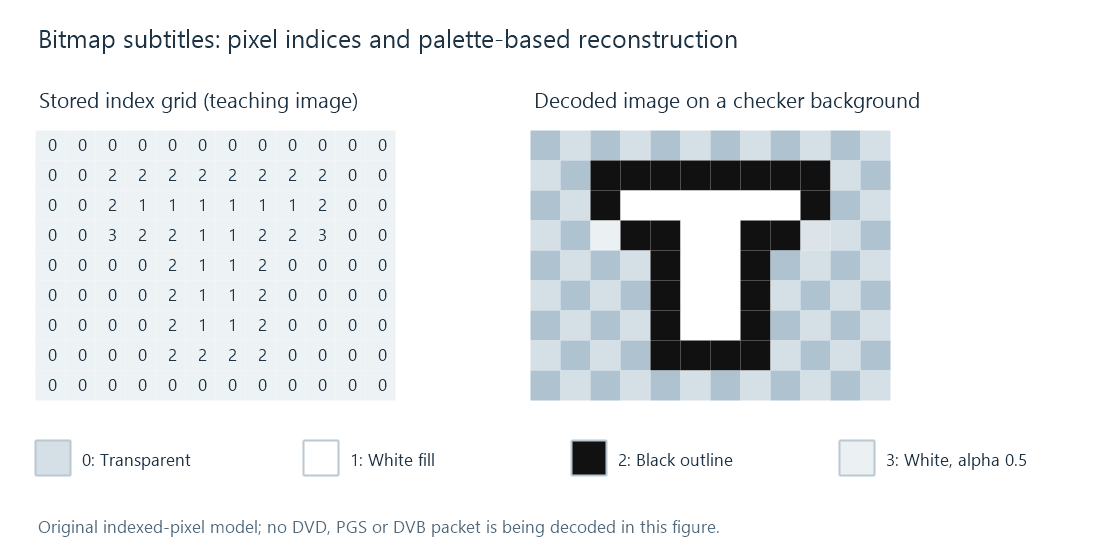
The figure is an original four-entry teaching image, not a packet from a disc or broadcast format. In a real format, palette syntax, run-length coding, transparency and update rules belong to that format.
A transparent background does not paint a black rectangular panel over the scene. An opaque outline can remain visible around white lettering, while partly transparent edge pixels can blend it with the underlying picture.
For a simplified linear-light blend, the result is:
output = alpha × subtitle colour + (1 − alpha) × video colour
White (1,1,1) at alpha 0.5 over video colour (0.1,0.2,0.3) gives (0.55,0.60,0.65). Fully transparent pixels leave the video unchanged. This illustrates compositing; it does not specify every renderer's colour pipeline.
The image occupies a subtitle plane
The format can describe a logical display size and position a cropped object within it. An image only 800 pixels wide can belong to a 1920-pixel-wide subtitle plane.
Suppose an object of 800 × 80 sits at (560,900) in a 1920 × 1080 plane. Mapping that plane uniformly to 1280 × 720 gives a factor of 2/3:
| Quantity | Scaled result |
|---|---|
| Object size | Approximately 533.33 × 53.33 |
| Position | Approximately (373.33,600) |
| Output plane | 1280 × 720 |
The compositor ultimately rasterizes onto integer output pixels, so its sampling and rounding policy matters. Scaling just the object while leaving its position in the old coordinate system would create a different layout.
Changing the output size rescales an existing image. It does not automatically select a new font or reflow the lettering into a new line length.
Selectable graphics and permanent pixels
A bitmap track remains separate data until composition. A player supporting the format can draw it over the movie and allow the viewer to disable it. If a server renders the subtitle into newly encoded video, its appearance becomes part of that video's pixels.
This is why “bitmap” and “burned in” are different descriptions. The first identifies the subtitle source representation; the second identifies what happened in an output route.
To create text from bitmap letters, a tool needs OCR or manual transcription. Copying the bitmap into another container is an extraction or packaging operation, not recognition. OCR must also recover punctuation, speaker cues and ordering; preserving an image is not evidence that those characters were recovered correctly.
In an Emby comparison, the delivered representation identifies whether the app draws a separate image or receives video with the subtitle already incorporated. The separate-image route keeps image placement and composition at the app; the incorporated route has completed them upstream.
See Also
- DVD subtitles: DVDSub and VobSub
- Blu-ray subtitles (PGS)
- DVB subtitles (DVBSub)
- Text-based subtitles