Controller and receiver connectivity
Remote playback depends on separate discovery, control and media-retrieval paths whose reachability and access contexts can succeed or fail independently.
A controller finding a receiver is one successful interaction in a remote-playback session. The receiver still needs control communication and access to the resources it will present.
Keeping discovery, control and media retrieval separate explains many apparently contradictory casting results.
Three paths can have different endpoints
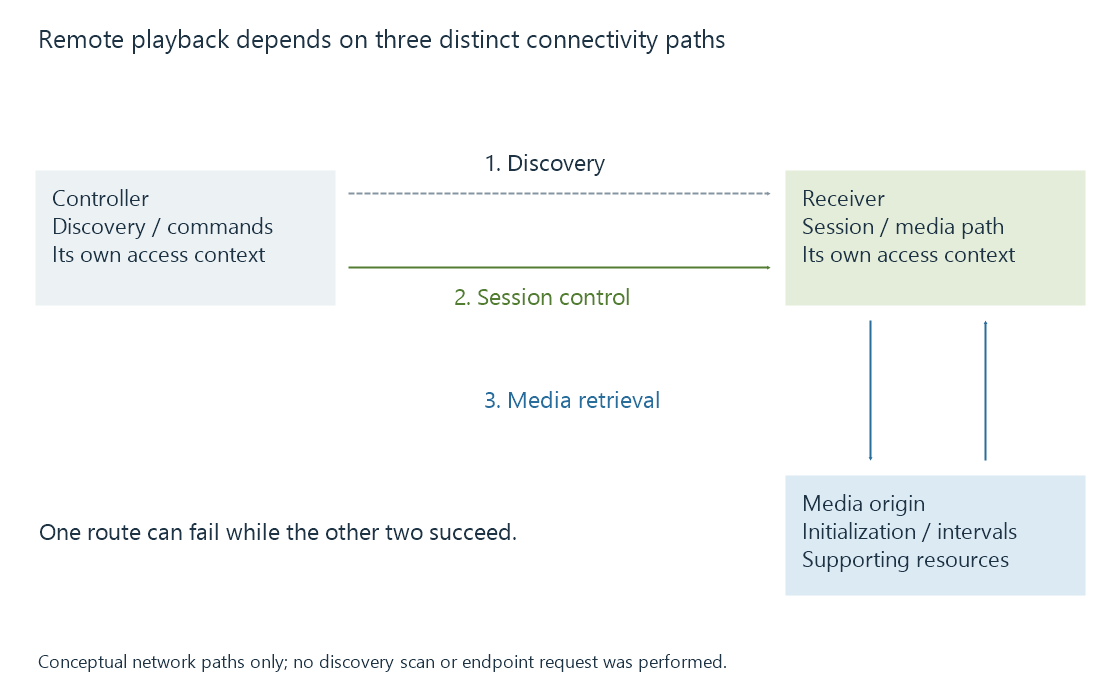
| Path | Purpose |
|---|---|
| Discovery | Locate an offered receiving device or service |
| Control/session communication | Activate a receiver and request actions |
| Media retrieval | Obtain the programme, initialization and supporting resources |
Discovery can use local-network mechanisms such as multicast service discovery. Media retrieval commonly uses unicast HTTP connections to a media origin. Their successful paths need not be identical.
For example, an original arrangement can have this result:
| Interaction | Result |
|---|---|
| Controller discovers receiver | Succeeds |
| Controller establishes receiver session | Succeeds |
| Controller obtains media from origin | Succeeds |
| Receiver obtains media from origin | Fails |
The first three results do not contradict the fourth. They involve a different initiating device or protocol path.
Addresses belong to the requesting device's context
Suppose a controller can obtain a resource at:
http://127.0.0.1:8096/media/example.mp4
This fictional locator points to loopback on the device making the request. Passing it unchanged to another receiver makes the receiver ask its own loopback address, not the controller's.
A server's local file path has a similar scope problem. The receiver needs a resource locator meaningful and reachable in its own environment.
Names also require receiver-side resolution. A hostname known on the controller need not resolve identically on another network segment or device.
Shared wireless access is useful context, not complete evidence
The documented consumer casting workflow often places devices on the same local network. A shared network name alone does not establish communication among every connected device: guest isolation, multicast handling, addressing and routed access can differ.
Google's discovery documentation treats receiver discovery as a distinct troubleshooting stage. That supports a focused investigation of whether discovery reaches the intended devices before drawing conclusions about the movie's codec.
The network topology is equally relevant when a controller can browse Emby Server remotely while the receiver tries another server address. Identify the address each device actually uses.
A reachable resource still needs the right access context
Successful TCP/HTTP reachability does not establish that a request is authorized or permitted through the receiving web player's loading rules.
A Web Receiver fetching across origins needs the applicable Fetch/CORS behavior. Session-specific resource access must also remain valid for the receiver's request. An authenticated controller's success is scoped to that controller request.
In segmented playback, the initial description, initialization, media and selected subtitle resources can each require access. Loading one playlist is not proof that all its resolved references can be obtained.
See Also
- Google Cast and receiver-side media playback
- AirPlay media presentation and screen mirroring
- DLNA media playback and UPnP AV roles
- Playback remote control and reported session state
- Browser media playback and its loading paths
- What determines playback compatibility?