Server user identity and scoped account state
Server user identity associates a local account with its state and policy within one server, separately from display labels, device identity and optional Connect linkage.
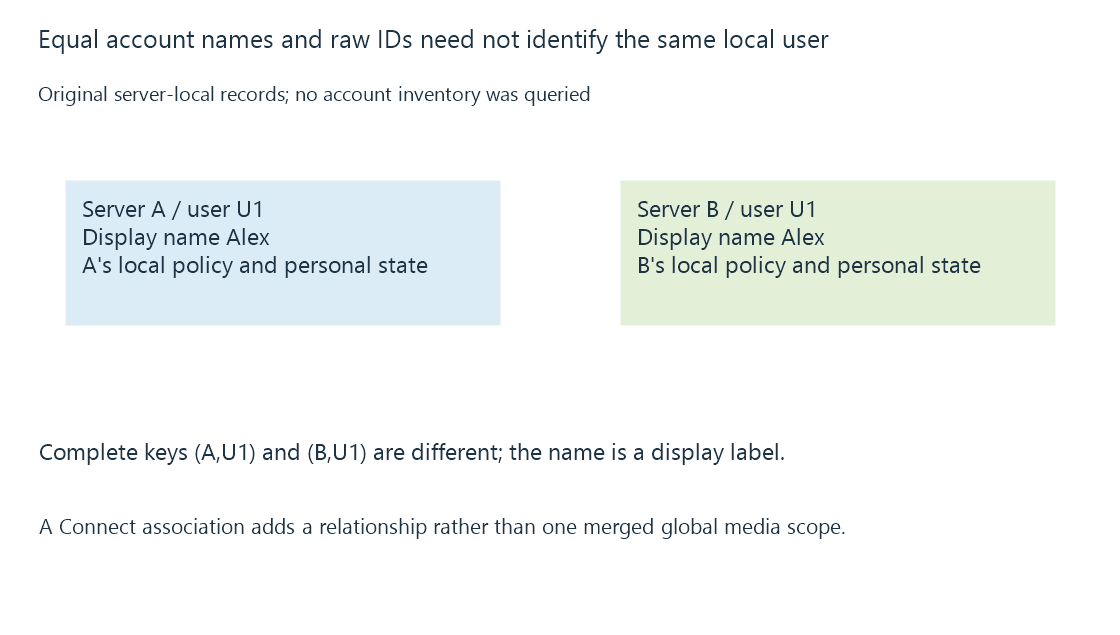
Two servers can each have an account named Alex. They are not one account merely because the displayed names match.
An Emby server’s local user identity owns that server’s account state and policy relationships.
A complete identity retains server scope
Use this original inventory:
| Server | Local user ID | Display name |
|---|---|---|
| A | U1 | Alex |
| B | U1 | Alex |
| A | U2 | Family |
The first two raw user IDs match too, but the complete keys (A,U1) and (B,U1) refer to different local objects.
[
  {"serverId": "A", "userId": "U1", "name": "Alex"},
  {"serverId": "B", "userId": "U1", "name": "Alex"}
]
The example values are fictional rather than native returned Emby IDs.
A client’s saved token and selected server should retain that same scope.
Names and devices have another lifetime
A renamed user can keep its local identity and associated state. A recreated account with an equal display name can be another object.
A device identifier describes a client/device relationship, not the user’s entire identity. Several users can use one television, and one user can use several devices.
The current request/session supplies which account is active. The hardware’s friendly label does not select that account’s permissions by itself.
Personal media state belongs to the account context
Watched progress, favorites and recommendations can vary by user on the same server.
User history describes that state. The shared media item and each account’s personal association are different records.
A permission change can alter which items the user sees without changing the underlying shared library object. A metadata correction can change the item while the personal relationship remains scoped to the relevant user/item identities.
Connect linkage adds an association
Emby documents optional linking of a local user with a Connect identity. That assists sign-in and server location.
The local account remains the server’s policy/state object. A central identity link does not merge all local accounts into one universal library permission set.
See Also
- Media server authentication and credential evidence
- Emby Connect and the path to the selected server
- User-specific playback history
- Library access permissions and the user’s media scope