Sort titles
A sort title is a presentation-order key that can differ from the displayed title, with locale, numeric and tie-breaking policies determining the resulting sequence.
A sort title controls presentation order without necessarily replacing the displayed title. A library can show The Station while ordering it under Station.
The examined Emby NFO parser maps sorttitle separately from the item name. That provides a concrete distinction between display wording and an ordering field.
Removing an article is a language decision
| Display title | Original illustrative sort key |
|---|---|
| The Station | Station |
| A River | River |
| Station II | Station II |
This example uses English presentation rules. Applying the same article-removal list to every language can remove genuine title content or leave another language's article untouched.
An explicit authored sort title can retain that decision. It should not be treated as another work identifier.
Collation adds an ordering context
An original locale experiment uses the strings A, Z, Å. An English collation can place Å with the A group; Swedish places Å after Z.
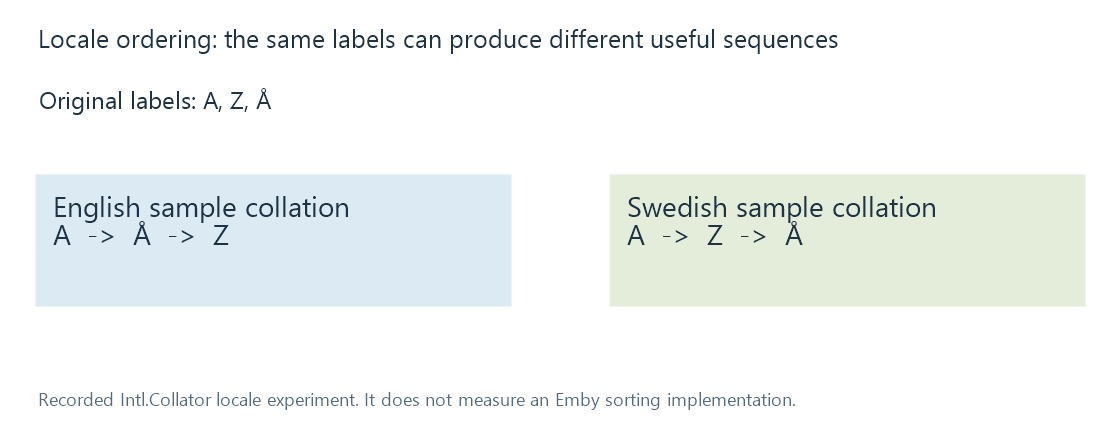
The illustrated results use a recorded runtime's Intl.Collator with explicit locales. They are not a measurement of Emby's current sort routine.
Code-point order, normalized byte order and human language collation need not produce the same sequence. Unicode metadata develops the preceding normalization boundary.
Numeric ordering is another choice
Lexical ordering can place Station 10 before Station 2, because it compares the first differing character. A numeric-aware collation can instead compare the number values and place 2 first.
That option should not silently reinterpret opaque provider IDs as numeric title fragments. Its useful scope is the chosen display-order key.
Equal keys need a stable tie-break
Two entries can legitimately have the same sort title. A stable secondary criterion, such as another defined field and ultimately an item identity, can make pagination consistent.
Without a coherent ordering, moving through pages can repeat or miss entries when equal-key positions change. The ordering model and current dataset determine that behavior.
For Emby, compare the displayed title, available sort field and selected view's order. Editing only the display name need not change a deliberately retained sort key.