HDHomeRun network tuner routes
HDHomeRun exposes model-specific broadcast reception through a network source whose channel inventory, stream acquisition and diagnostic fields have separate scopes.
HDHomeRun is a family of network TV sources. A compatible model recovers broadcast services and exposes channel/media interfaces that another application can use.
Emby’s HDHomeRun integration concerns that supported source route. Discovery, channel inventory and a playable service are separate results.
The model determines the reception resources
HDHomeRun products have different broadcast-system and resource arrangements. A general brand name does not identify ATSC, DVB or CableCARD support for every model.
The manufacturer lists particular ATSC 3.0-receiving models, but that alone is not a statement that every tuner resource or every protected service is usable by every third-party app.
The exact device and its exposed capabilities belong with the source description.
Inventory and acquisition use different operations
The public HTTP API describes channel information such as GuideNumber, GuideName and relevant tags. A listed channel number identifies a request in that source’s lineup.
Its media request then needs available acquisition resources, a supplied programme and any required supported access path.
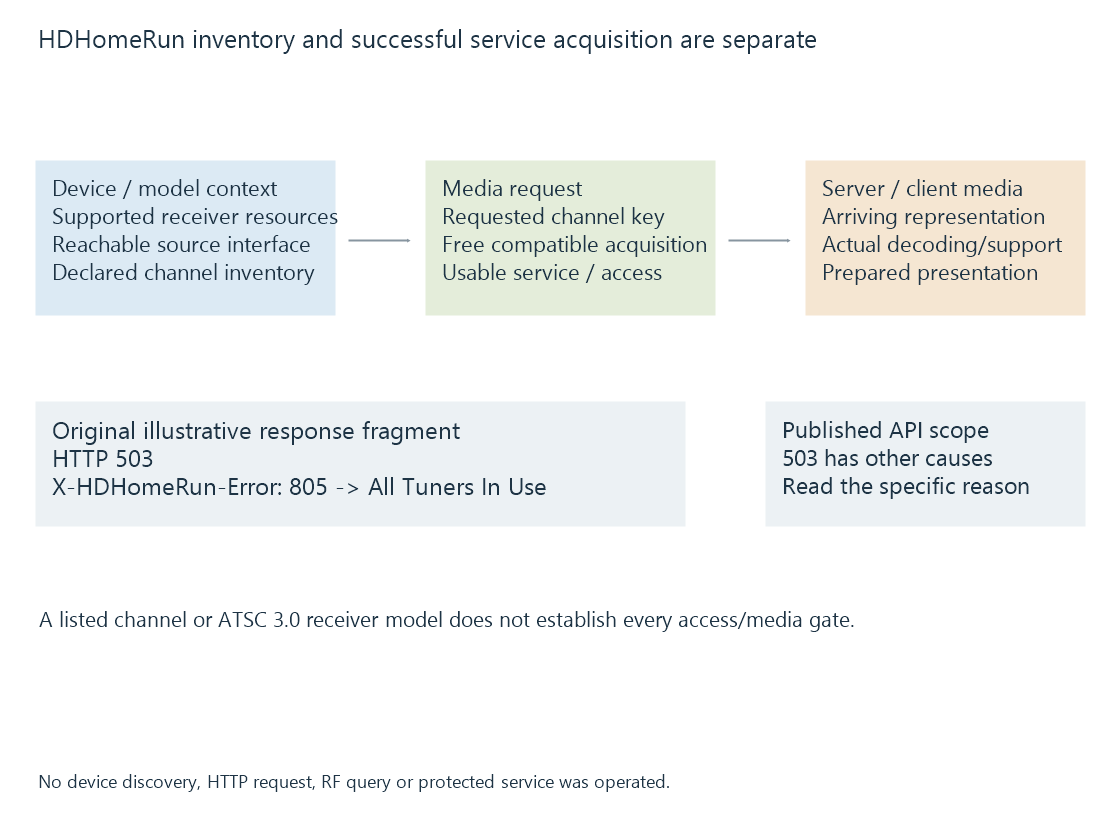
A channel’s presence in the lineup does not prove that its current request returns usable video.
One HTTP status can describe several failures
The manufacturer documents a more specific error header alongside HTTP status. Its API gives these relevant distinctions:
| API condition | Published response context |
|---|---|
| Unknown virtual channel | 404 |
| No available tuner | 503, with the corresponding tuner-use reason |
| Requested programme not found/authorized in the described interval | Can produce 503 |
| Required content-protection path not requested | Can produce 503 |
For an original illustrative response:
HTTP status: 503
X-HDHomeRun-Error: 805
The published meaning of 805 is “All Tuners In Use.” This fragment is not a captured response.
A bare 503 is consequently too broad to identify that cause on its own. A source can be discoverable and its lineup readable while this later media request cannot proceed.
Diagnostic fields locate another boundary
| Manufacturer diagnostic family | Role |
|---|---|
| RF lock/strength/quality | Reception context |
| Transport error counters | Recovered-data integrity context |
| Filtered/output bitrate | Data selected or emitted by the source |
| Network packet/output information | Later delivery progress |
Signal strength and quality develop their interpretation. A report should retain the field’s scale and observation interval.
An RF error already present in the recovered transport differs from a continuous source output whose packets fail to arrive at Emby Server.
Protected services require their supported end-to-end route
The manufacturer’s CableCARD protection documentation describes particular supported protected-channel arrangements. It is not a promise that a generic HTTP client or third-party media server can consume every protected channel.
Likewise, supporting ATSC 3.0 reception does not itself establish a protected-service path in Emby.
The receiving model, selected service, exposed interface and actual access/media requirements determine which operation reaches the client. Encrypted TV channels develops those gates separately.
See Also
- Network TV tuners
- Encrypted TV channels and supported playback paths
- Channel lineups and source identity