Virtual channel numbers
Virtual channel numbers provide viewer-facing labels mapped through defined signaling or source information to the physical transport and programme actually acquired.
A virtual channel number is a viewer-facing label connected to service identity through the applicable signaling/source arrangement.
In the ATSC major/minor form, 7.1 does not mean the receiver necessarily tunes physical RF channel 7.
One RF transport can have several familiar labels
Use this original mapping:
| Display label | Physical RF label | Transport ID | Programme number |
|---|---|---|---|
| 7.1 | RF22 | 100 | 3 |
| 7.2 | RF22 | 100 | 4 |
| 12.1 | RF31 | 200 | 8 |
The first two display channels share a physical acquisition context while selecting different programmes.
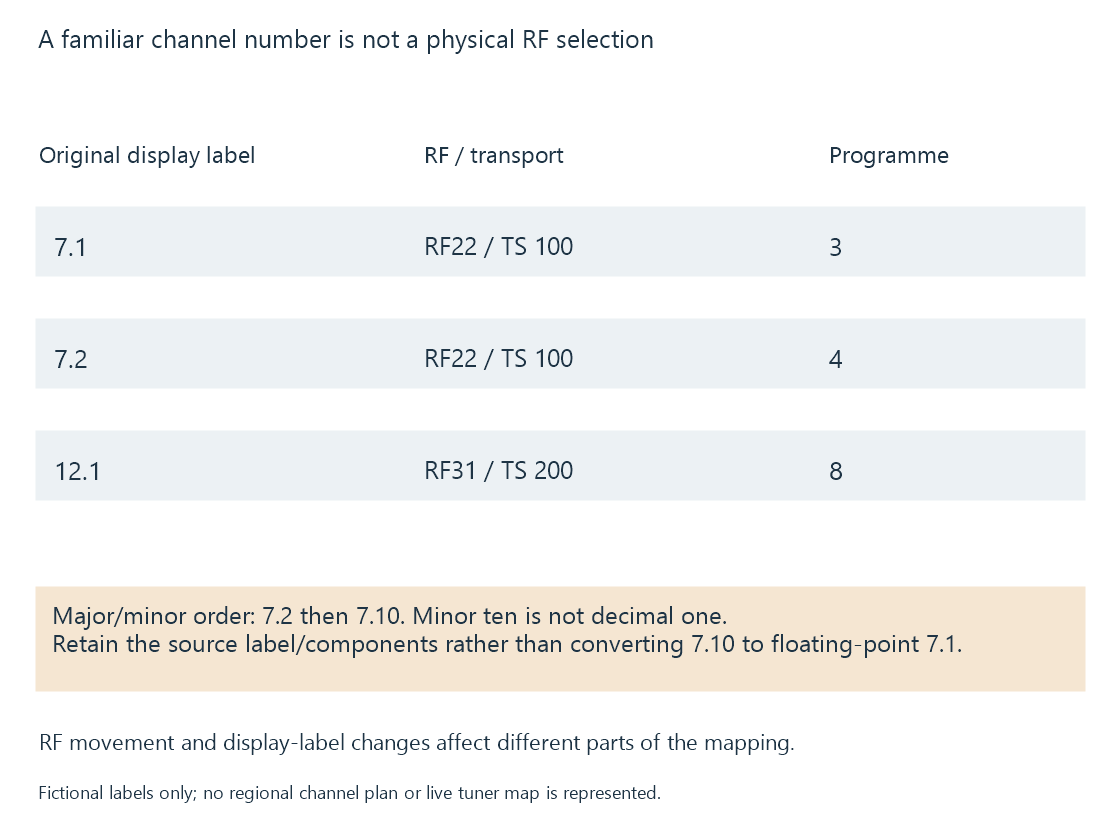
The table is fictional and its RF labels are not a frequency plan.
ATSC A/65’s virtual-channel information associates the display labels with relevant transport/programme fields. A receiver uses those relationships rather than interpreting the displayed number as an RF tuning command.
The label can remain while the physical route changes
If the first service moves from RF22 to another compatible acquired transport, the receiver/backend needs updated tuning and signaling information.
The displayed identity can remain 7.1 under the applicable updated mapping. A familiar label does not prove that cached physical parameters are still correct.
Conversely, editing a label in a media-server interface need not change where the source actually tunes. Service identifiers and lineups separate those operations.
Major/minor labels should not become floating-point values
Consider 7.2 and 7.10.
Their major number is seven; their minor numbers are two and ten. They are not decimal fractions 7.2 and 7.1.
An original major/minor ordering therefore gives:
7.2
7.10
Lexical ordering of strings can put 7.10 before 7.2. Converting them to floating-point values can erase the distinction between 7.10 and 7.1.
The appropriate data representation retains both components or the exact source label according to the interface contract.
The source context still belongs to the channel
Two different sources can both expose a label such as 7.1 without representing one interchangeable acquisition.
HDHomeRun’s API uses GuideNumber in its defined lineup context. Emby’s source key and guide association connect that visible number to the intended programme.
See Also
- Broadcast service identifiers
- Channel lineups and source identity
- ATSC 1.0 broadcast television
- HDHomeRun network tuner routes