Music release groups
A MusicBrainz release group gathers related release products under a common album or release concept while retaining each product’s identity.
A release group answers a broad album question: “Which album concept do these products belong to?” A release answers the narrower question: “Which issued product is this?”
The original and expanded Harbour Songs products can therefore belong to one release group. Their different disc counts, artwork and release events remain properties of the individual releases.
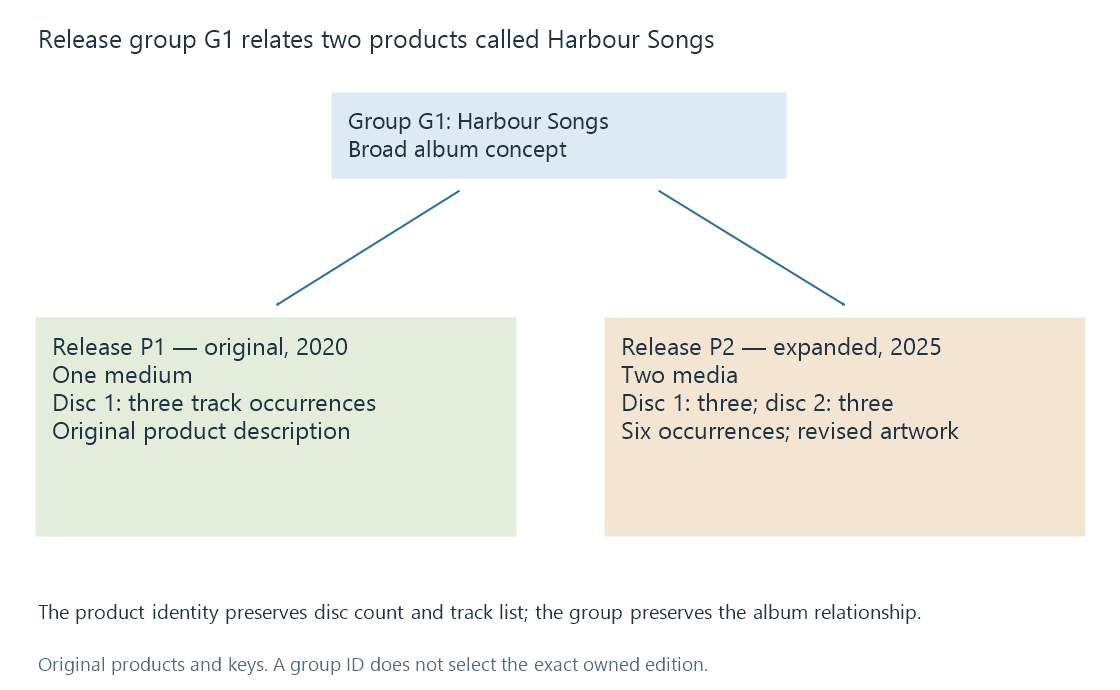
MusicBrainz uses release group as a defined catalogue entity. Each release belongs to one such group in its model. A personal group of favourite albums, a genre view or a playlist is a different kind of association.
| Identity | Suitable question |
|---|---|
| Release group G1 | Which overall Harbour Songs album concept? |
| Release P1 | Which original issued product? |
| Release P2 | Which expanded issued product? |
| Medium 2 of P2 | Which disc within the expanded product? |
The labels are invented keys for this example. A disc within a multi-disc product is not automatically another release or release group.
Broad matching and precise matching
A group-level match can be enough to discover album information or relate editions in a catalogue. It cannot select the exact product's track list when those editions differ.
For example, using G1 to identify P2 still leaves unanswered whether the library should contain three tracks on one medium or an additional disc. A release ID can resolve that product question; a group ID cannot substitute for it.
The same issue appears with dates. The broad album concept and a 2025 expanded product can legitimately carry different release contexts. Overwriting the expanded product's date with a group's original-release context erases the edition distinction.
Reading an album ID
Tagging software can store both release and release-group identifiers. The field name matters because the UUID's text does not announce its entity type.
An Emby library reading embedded album information needs consistent release evidence for the product being presented. The group relationship explains why several products are related, while the release description preserves which one the files represent.
See Also
- Music releases and album editions
- Music recordings and track occurrences
- Media collections
- MusicBrainz identifiers