MusicBrainz identifiers
MusicBrainz identifiers are UUID-shaped keys for distinct music entities, so recording, release and release-group references must retain their intended scope.
A MusicBrainz Identifier, or MBID, is a UUID-shaped reference to a MusicBrainz entity. It is not a hash of an audio file and does not contain a readable artist/title description.
Shape and entity scope belong together
An invented UUID-shape example is:
11111111-2222-4333-8444-555555555555
This demonstrates textual form only; it is not supplied as a MusicBrainz lookup for a real artist or release.
| Entity | Meaning needed for matching |
|---|---|
| Artist | A credited artist entity |
| Recording | An audio recording relationship |
| Release | A particular issued product/edition |
| Release group | The broader grouping of related releases |
| Work | A musical-work relationship |
The key's spelling does not tell the reader which field it belongs in. Preserve the associated entity context instead of treating every music UUID as an interchangeable album ID.
One recording can have several release contexts
Take an invented recording, Platform Lights. It appears as track 2 on a standard album and track 5 on a later compilation.
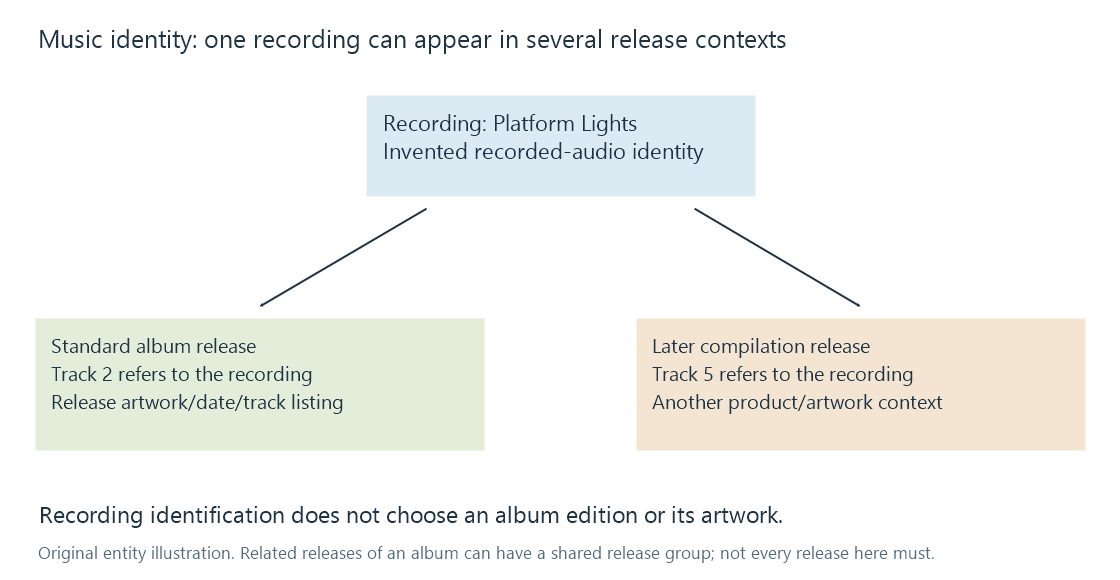
Matching that recording identifies an audio relationship. It does not decide which release's cover, date, barcode or track order belongs to the local album.
A release group can collect several issued releases of the broader album concept. The standard and deluxe releases can share that group while having different product details and track lists.
A track belongs to its release/medium context and references a recording. Keeping those levels separate avoids using a track position as if it were an intrinsic property of the recording.
A fingerprint supplies evidence, not every identifier
An acoustic match can help identify recorded audio. It need not establish the physical or digital edition from which the file came.
Combine that evidence with release tags, artist credits, track lists and other appropriate product information. Acoustic fingerprinting develops that separation.
Different encodings can share an audio relationship while having different byte hashes. An MBID does not verify that two local files have identical encoded content.
Merges can preserve earlier references
MusicBrainz documents redirects when entities are merged, and one entity can consequently have more than one associated MBID. A redirect is a provider-defined identity relationship, not permission to discard entity type.
For Emby music matching, distinguish recording/artist references from release or release-group context. Music naming documentation provides the product's local library guidance; the provider's model explains why a plausible UUID in the wrong field can still select the wrong metadata.