Comic book archives: CBZ and CBR
A comic book archive packages page-image resources and optional descriptive metadata whose archive format, reading order and page roles require separate interpretation.
A comic archive commonly stores a sequence of page images in one archive resource. CBZ conventionally uses ZIP; CBR uses RAR. The archive organises stored entries, while a comic reader interprets which images to display and in what sequence.
Those are different jobs. Renaming a RAR archive to .cbz changes a filename, not its compression format.
Archive, page image and presentation
| Layer | Question it answers |
|---|---|
| ZIP or RAR container | How are the entries stored and retrieved? |
| JPEG, PNG or another page-image format | How is each picture encoded? |
| Comic metadata | Which issue, contributors and page roles are described? |
| Reader presentation | Which page, spread, direction and zoom are shown? |
Repackaging page entries can preserve their image bytes. Resizing or recompressing those images changes another layer. A reader's zoom changes the displayed view without rewriting the stored pages.
Page order needs an agreement
An original filename set demonstrates the issue:
1.jpg
2.jpg
10.jpg
Simple lexical order places 10.jpg before 2.jpg. A natural-number sort can instead interpret the numbers. Zero-padded names make the intended sequence explicit for many lexical readers:
001.jpg
002.jpg
010.jpg
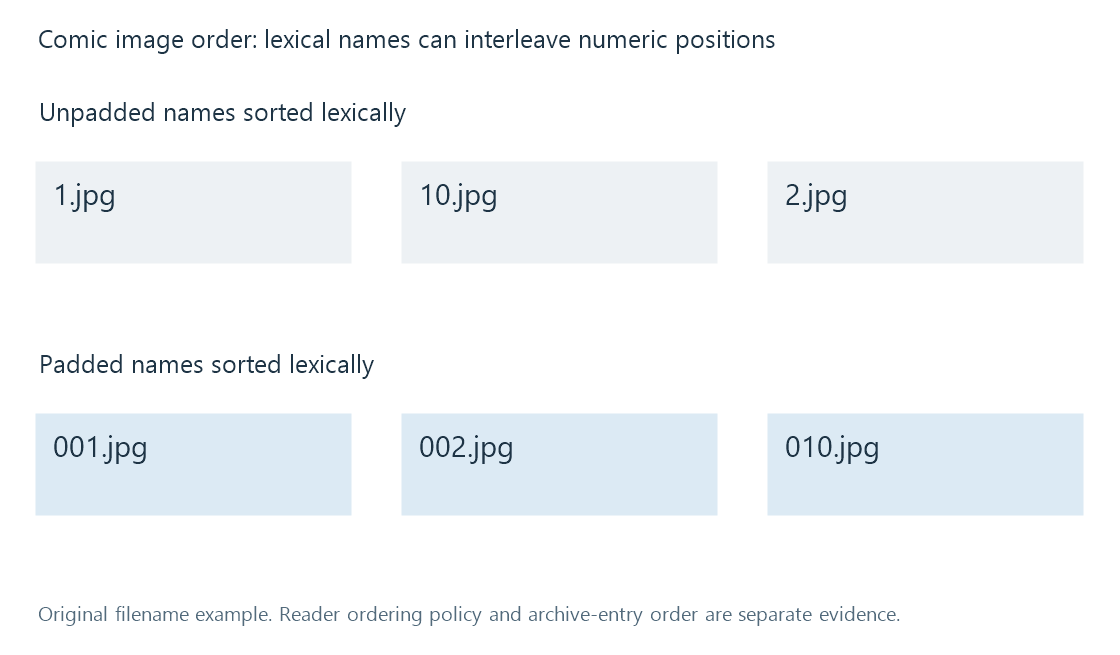
An archive's internal entry order, filename order and metadata page order are not necessarily the same. The reader's actual policy determines which evidence it uses. Nested directories can introduce further grouping, so the complete paths matter as well as the basenames.
A cover image can be part of the page sequence. Advertisements, title pages and double-page spreads can also be deliberate entries. Counting only story pages need not equal counting all stored images.
Metadata describes the issue and its pages
ComicInfo.xml is one used metadata convention, documented by the Anansi Project. An original small fragment is:
<ComicInfo>
  <Title>The First Crossing</Title>
  <Series>Harbour Stories</Series>
  <Number>7</Number>
  <PageCount>3</PageCount>
  <Pages>
    <Page Image="0" Type="FrontCover" />
    <Page Image="1" Type="Story" />
    <Page Image="2" Type="Story" DoublePage="true" />
  </Pages>
</ComicInfo>
Issue number 7 identifies a position in the described series. Image index 0 identifies a page resource in this page model. The first visible page can therefore be the cover of issue 7, not “issue 0” or “story page 7.”
A double-page indication describes a spread role. It does not require every reader to display the same two-screen layout. A wide page image, page metadata and viewport policy each contribute to presentation.
The fragment is an original descriptive example. Its presence does not guarantee that every library or reader imports all its fields.
Image quality affects reading
Small text and line art can be sensitive to source resolution and compression. Enlarging a low-resolution page does not recover missing lettering detail. Cropping a spread can remove part of the panel sequence.
Image orientation and the reader's handling of it also matter. Metadata that directs a rotation is different from rewriting the stored pixels.
Emby's Book Naming documentation includes CBR and CBZ among book resources. That recognition does not specify every reader's sorting, metadata or spread behavior. The archive format, ordered image resources and described page roles provide the information needed to interpret the publication.