DisplayPort video links
DisplayPort carries presentation streams over a negotiated link with separate lane/rate, stream-format and capability relationships.
DisplayPort transports a prepared presentation signal from a source toward a display. Like HDMI, it describes the local display connection rather than the compressed movie delivered by Emby Server.
Its link has an implemented lane count and rate. The picture streams carried through that link have their own timing and sample-format requirements.
The main link and AUX path serve different work
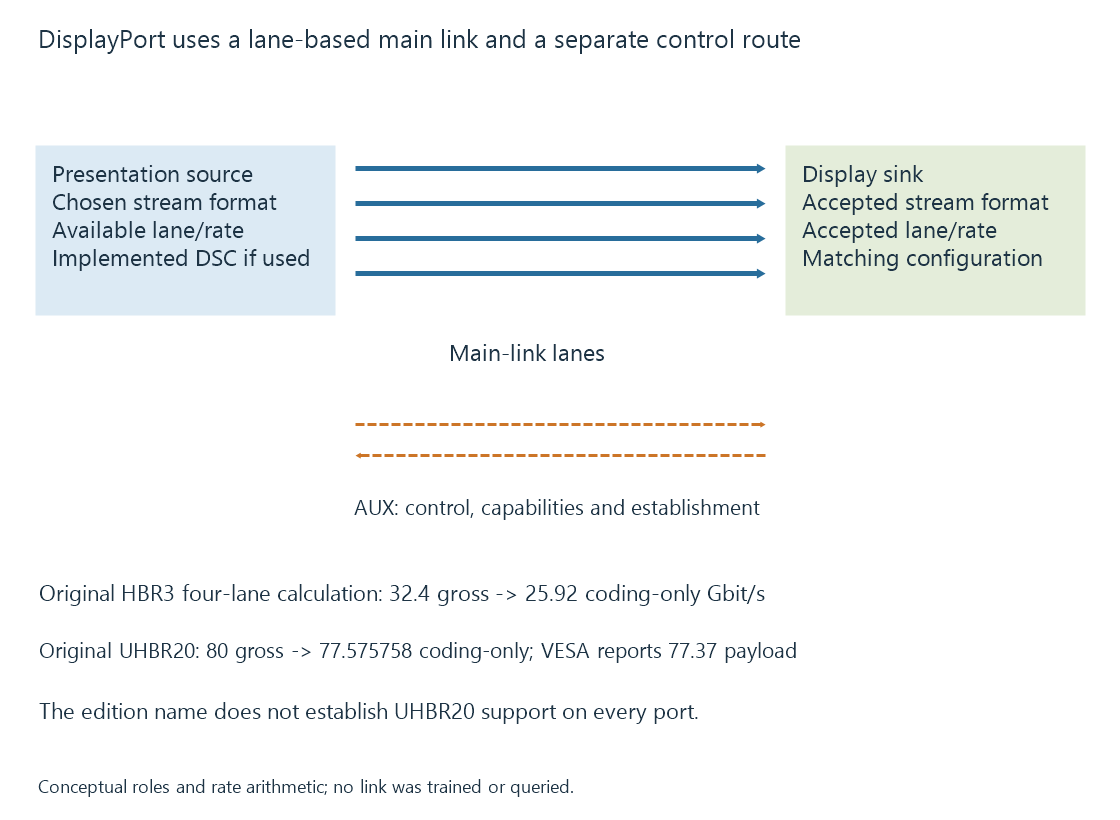
The main link carries the presentation stream. The AUX relationship supports control and capability operations such as reading relevant device information and establishing the link.
A source needs both suitable stream properties and a usable trained link. Reading a display’s declarations does not prove that the main link is carrying the intended signal successfully.
EDID supplies display declarations within the appropriate arrangement; other DisplayPort capability information also participates.
Four lanes do not all use the same rate or coding
Use two original four-lane arithmetic exercises:
| Declared link | Gross lane total | Coding-only ceiling |
|---|---|---|
| Four HBR3 lanes at 8.1 Gbit/s each | 32.4 Gbit/s | 25.92 Gbit/s after 8b/10b expansion |
| Four UHBR20 lanes at 20 Gbit/s each | 80 Gbit/s | 77.575758 Gbit/s after 128b/132b expansion |
These ceilings remove only the stated channel-coding expansion. They are not complete active-picture capacity calculations.
VESA’s DisplayPort FAQ gives 77.37 Gbit/s as the maximum payload for its stated four-lane UHBR20 arrangement. Additional transport accounting explains why the simple 80 × 128/132 ceiling is a different number.
The requested mode also has timing, color precision, chroma and possibly DSC requirements. Gross rate alone does not prove a particular uncompressed mode fits.
The edition does not identify every feature
The current VESA FAQ discusses DisplayPort 2.1b, including that certification can encompass devices without UHBR rates. Its product feature declarations are therefore still needed.
“DisplayPort 2.1b” cannot be expanded into “this exact port always supplies four UHBR20 lanes.” The actual source, sink, cable and implemented path determine the selected configuration.
A laptop’s integrated output and a separate graphics card can expose different link resources even if their marketing descriptions use the same edition name.
Adapters introduce another interface
A DisplayPort-to-HDMI converter receives one transport and generates another. Its accepted DisplayPort mode and produced HDMI mode are separate constraints.
A passive dual-mode arrangement and an active protocol converter are not the same mechanism. Which route is present belongs to the device/adapter specification.
Likewise, a dock can share link resources between several displays or other traffic. A mode working on one direct display does not prove that an expanded dock topology retains the same budget.
USB-C DisplayPort Alt Mode develops the connector and lane-allocation relationship.
The stream is the local presentation
An Emby client can keep a high-resolution desktop output while playing lower-resolution content within it. The DisplayPort stream then describes that desktop presentation.
See Also
- USB-C DisplayPort Alt Mode
- Display Stream Compression (DSC)
- HDMI video transport
- Variable refresh rate (VRR)