LCD and LED-backlit displays
An LED-backlit LCD forms pictures by modulating a separate backlight through a liquid-crystal pixel structure.
Most televisions described as LED TVs use an LCD panel illuminated by LEDs. The LEDs provide light; the liquid-crystal structure controls how much of it reaches the viewer at each pixel.
The names refer to different parts of the same display.
The light source and the picture grid
An LCD’s backlight passes through optical layers and the pixel structure. Pixel drive changes the liquid crystal’s effect on polarization, allowing different amounts of light through the relevant color channels.
| Term | Part of the arrangement |
|---|---|
| LCD | Liquid-crystal modulation of light |
| LED backlight | Light source behind or around the panel |
| Mini-LED backlight | A backlight using smaller LED elements and an implemented zone arrangement |
| OLED | An emissive pixel technology with a different light-producing principle |
A quantum-dot color-conversion layer can alter the backlight’s spectral/color properties while the display still uses an LCD to form its picture.
The number of LEDs is not necessarily the number of independently controlled local-dimming zones. Several emitters can share one zone’s drive.
A bright subtitle and a dark background compete
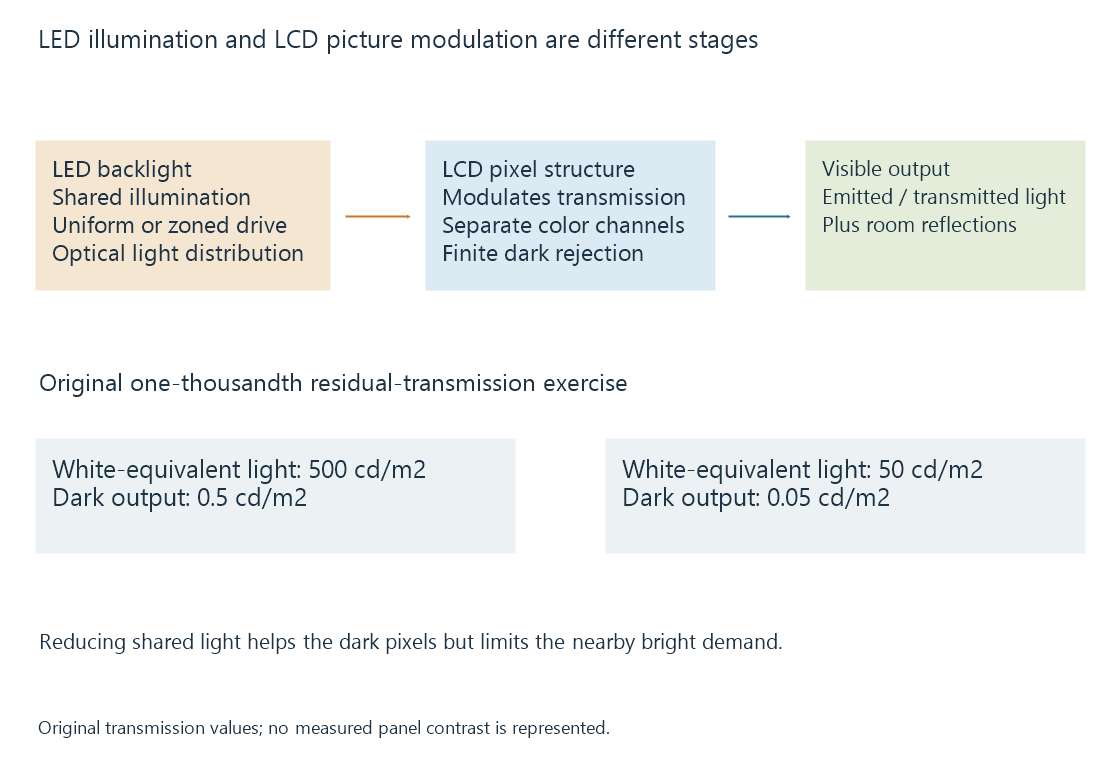
Imagine an original zone containing a bright subtitle and nearby dark picture pixels. Raising the zone’s light helps the subtitle reach its intended brightness. The LCD’s dark pixels must then reject that same stronger illumination.
If their residual transmission is one-thousandth of the white transmission, a declared 500-cd/m² white gives a simplified 0.5-cd/m² dark result. Reducing the zone’s white-equivalent light to 50 cd/m² lowers the residual to 0.05, but also limits the subtitle’s brightness.
These are invented transmission values, with ambient reflections omitted. They explain why a zone controller makes a spatial compromise. They are not measurements of a particular LCD.
An Emby subtitle overlay can therefore change the visible local contrast even when the video stream and subtitle timing are correct.
Backlight arrangement changes the compromise
A uniformly driven backlight sets one light level across the screen. Edge-lit or direct-lit local control divides that responsibility into zones.
Smaller appropriately controlled zones can isolate bright objects more closely. Their boundaries, optical light spread and control decisions still matter. A zone can illuminate pixels beyond the object that caused it to brighten.
The panel’s own dark-state transmission also matters: adding more zones does not replace that property with perfect rejection.
Pixel transitions and light timing affect motion
Changing a pixel from one gray level to another takes a finite response. Different transitions can take different amounts of time, and overdrive can alter both speed and overshoot.
Separately, the backlight can illuminate continuously or use a timed pattern. A quickly changing LCD pixel under a long light hold can still produce tracking blur.
Display response time separates transition speed from persistence. Those properties explain why two LED-backlit LCDs with the same resolution can show a moving edge differently.
See Also
- OLED displays
- Local dimming and backlight zones
- Display response time and motion blur
- HDR display capabilities