Automatic brightness limiting
Automatic brightness limiting reduces permitted display output as picture loading reaches the implementation’s power or drive constraints.
A small white highlight and a white screen can request the same local luminance but require very different total light output. Automatic brightness limiting, often abbreviated ABL, describes a display reducing permitted output when the larger picture load reaches an implemented limit.
The result can be visible when a white window expands or a movie cuts to a largely bright scene.
The picture changes the total load
An emissive display drives the light-producing elements themselves. Lighting many elements strongly increases combined electrical loading compared with a small bright region surrounded by dark pixels.
Dell documents a picture-pattern loading effect on specified OLED laptop panels: darker regions leave more power available for bright regions. This provides a concrete product example of the mechanism, rather than a universal curve for every OLED.
The display’s exact response depends on its implementation, mode, color demands and time. ABL does not define one standard luminance-versus-area function.
An original power-budget curve
For a deliberately simplified model, assume a white patch covers fraction f of the screen, the background emits no light, and power is proportional to f × L.
Let the local luminance ceiling be 600 cd/m² and the allowed full-screen-equivalent light load be 180 cd/m². The model’s permitted patch luminance is:
L(f) = min(600, 180 / f), for 0 < f ≤ 1
| White area | Declared allowed luminance |
|---|---|
| 10% | 600 cd/m² |
| 25% | 600 cd/m² |
| 50% | 360 cd/m² |
| 100% | 180 cd/m² |
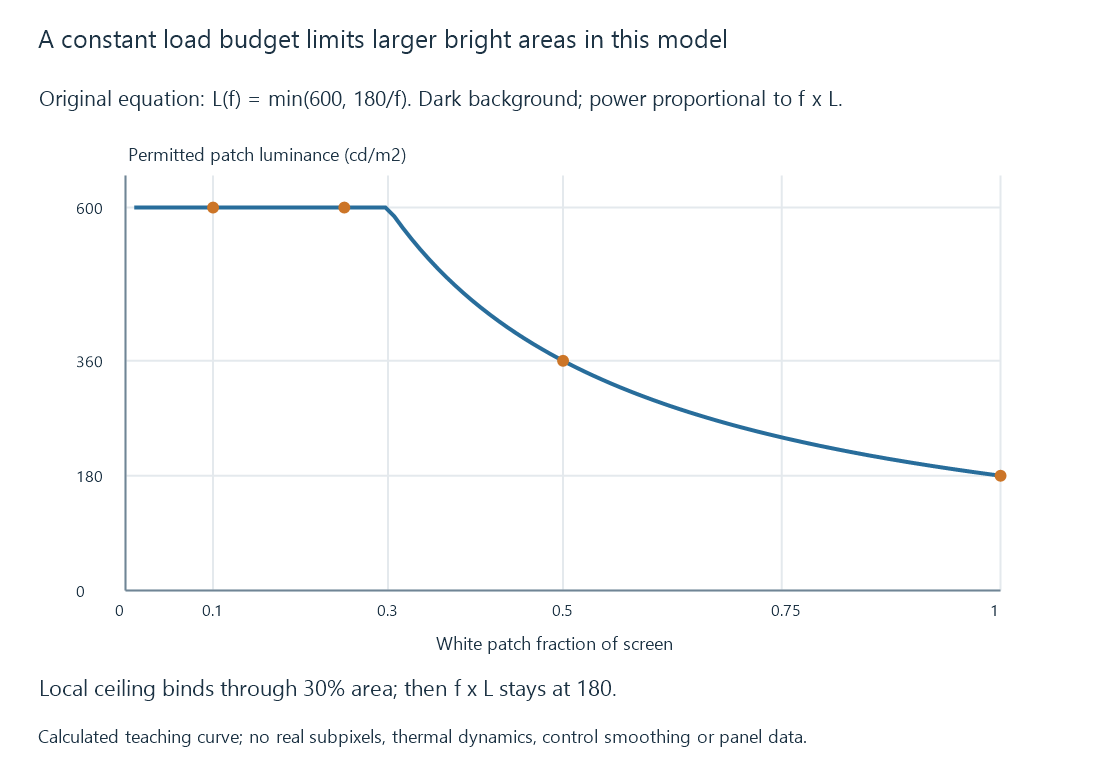
Below 30% area, the local ceiling is the binding constraint. Beyond it, the constant total-load condition limits the patch.
The model omits real subpixels, color-dependent efficiency, background light, thermal dynamics and control smoothing. It is not a measured panel response or a way to calculate a product’s ABL from its peak specification.
Other automatic dimming has different triggers
An ambient-light feature responds to the environment. A static-image protection policy can respond to persistent picture structure over time. Local dimming responds to regional demands on an LCD backlight.
These processes can coexist, so a brightness change should be described by its trigger. “It dimmed” alone does not identify which one operated.
Changing white area while retaining the same local signal values is evidence for a loading relationship. Changing room illumination while the picture is fixed addresses another relationship. A slow change after an unchanged picture has remained visible concerns time as well as area.
The encoded source can stay identical
In an Emby scene, the decoder can continue producing the same bright pixel values while the display changes the light emitted from them.
Subtitles, a menu or a larger bright picture region can alter the combined presentation sent to the display. Consequently, a brightness difference need not imply a different server bitrate or failed decoding.