Scene-Adaptive Tone Mapping
Scene-adaptive tone mapping changes its mapping over time according to the brightness characteristics of the current scene.
A tiny flash enters the window beside an otherwise stationary face. The source face stays at the same values, but the picture's detected peak rises. If a global mapper immediately changes its curve for that peak, the face can change brightness too. Scene adaptation needs to react to content without making that reaction distractingly visible.
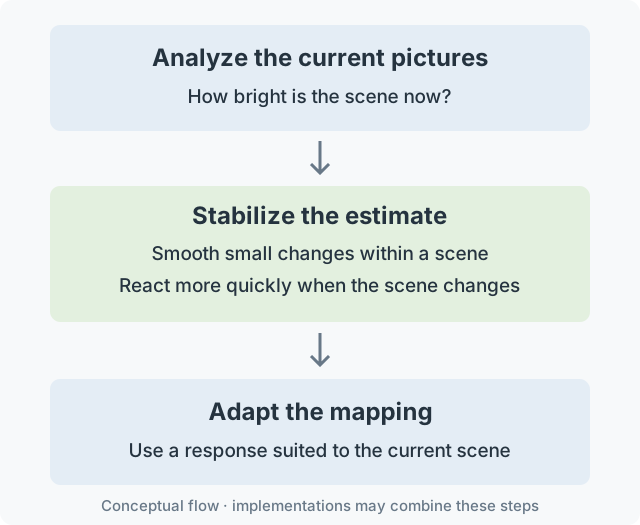
Conceptual responsibilities, not a description of one Emby implementation.
Watch a simple smoothing model respond
Let the estimated peak begin at 200 nits. In an illustrative model, update it as new estimate = 0.75 × previous estimate + 0.25 × new measurement. A single measured jump to 1,000 followed by a return to 200 produces:
| Frame event | Measured value | Smoothed estimate |
|---|---|---|
| Initial stable scene | 200 | 200 |
| Flash | 1,000 | 400 |
| Next ordinary frame | 200 | 350 |
| Following ordinary frame | 200 | 312.5 |
The model reduces the abrupt peak change, but its memory also leaves a smaller change after the flash. If those estimates control a global curve, they can still move the face's output over several frames.
This arithmetic isolates temporal lag. Actual detectors can smooth other representations, use different time constants, and discount exceptional samples through percentiles. The model is not a product setting or a claim that a library uses these coefficients.
A cut and a flash need different responses
Now replace the flash with a real cut to a bright scene. A slowly smoothed estimate can keep applying the previous scene's assumptions for too long. Scene-change handling can reset or accelerate adaptation when the measured change warrants it.
The tension is between stability inside a continuing scene and responsiveness to another scene. Brightness statistics are useful evidence but cannot always identify an edit unambiguously: camera motion, exposure changes, and flashes can also move them. Implementations choose detection and response policies for that ambiguity.
Prepared dynamic metadata supplies another source of changing information. It can describe a shot from production; runtime analysis instead estimates from the pictures received. Both still need coherent timing and appropriate transitions.
Keep temporal adaptation separate from spatial adaptation
A curve can change over time while remaining the same across one entire frame. Local processing varies by region within a frame and is another choice. Calling a mapper adaptive does not specify which dimension varies.
During an Emby test, let the picture move. Examine a stationary face when a bright object enters, then the first frames after a cut. Identify the processing location so the observed change can be attributed to the source, app, converter, or display. The temporal example explains why one attractive paused frame cannot establish stable adaptation.
See Also
- Peak-Luminance Detection for Tone Mapping
- Highlight Roll-Off in Tone Mapping
- What a Tone-Mapping Curve Controls