Interlaced Video
Interlaced video records alternating sets of picture lines as fields captured at successive times.
In a native interlaced recording, the camera represents movement with alternating sets of picture rows called fields. The first field supplies one row set; the next supplies the rows between them at a later capture time.
For a simplified zero-based grid, the top set contains rows 0, 2, 4, and so on. The bottom set contains rows 1, 3, 5, and so on. Each set spans the full height of the image. It is not the upper or lower half of the scene.
Capture a moving edge twice
In a 50-field/s sequence, a new field time occurs every 20 ms. Suppose a moving vertical edge is at horizontal position 20 in the top field at 0 ms, then at position 30 in the bottom field at 20 ms.
Weave the row sets together:
| Displayed row | Field's capture time | Edge position |
|---|---|---|
| 0, top | 0 ms | 20 |
| 1, bottom | 20 ms | 30 |
| 2, top | 0 ms | 20 |
| 3, bottom | 20 ms | 30 |
The alternating edge positions create a comb-shaped outline. Both fields can be correctly recorded and decoded: the error is treating their two times as one complete moving picture.
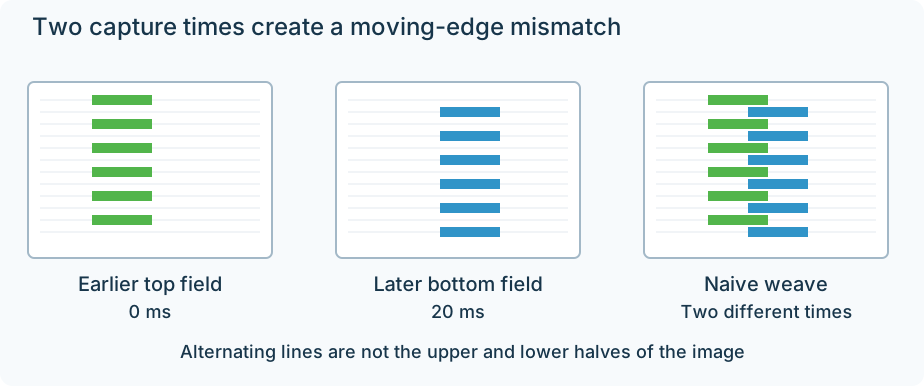
Original reduced-line schematic. Green lines belong to the earlier top field and blue lines to the later bottom field.
A static background can weave cleanly because it has not changed between field times. The same frame can therefore contain a sharp stationary region and a combed moving object.
Count fields and pairs separately
| System timing | Distinct field times per second | Pairs of fields per second |
|---|---|---|
| 50-field system | 50 | 25 |
| 60000/1001-field system | Approximately 59.94 | Approximately 29.97 |
A media inspector reporting 25 frame pairs/s and a television description using 50 fields/s can be describing the same recording. The pair combines enough rows for the full raster, but native capture supplied those rows at two different times.
Field order says which row set came first. Reversing it swaps the temporal order within each pair, producing backward steps in otherwise steady movement.
Why interlacing was a useful tradeoff
A 1920 × 1080 interlaced raster has 540 main-grid rows in each field. At 50 fields/s:
1920 × 540 × 50 = 51,840,000 sample positions/s.
A 1920 × 1080 progressive sequence at 25 frames/s has the same main-grid count per second:
1920 × 1080 × 25 = 51,840,000.
The interlaced representation allocates that sample count to more frequent motion times, with only alternating rows available at each one. A 1080p50 sequence supplies the complete raster at all 50 times and doubles this particular sample count.
These are uncompressed grid counts, not encoded bitrate predictions. They expose the spatial-versus-temporal allocation that explains the format.
Present it on a progressive screen
Deinterlacing builds complete output pictures from the available fields. For native 50-field movement, producing one progressive picture for each field gives 50 output times. Each picture must reconstruct the rows missing at its own time.
Producing only one picture per pair gives 25 output times. It can preserve the programme's duration while retaining fewer of its original motion moments. This is why a converted broadcast recording can keep its 1080-line height yet become less fluid.
Finally, inspect what the fields represent. Telecine distributes existing progressive film pictures over repeated field intervals, while PsF divides one progressive frame into two segments. Those sources call for matching existing picture rows rather than treating every field as a new camera moment.