HTTPS and TLS: transport protection and peer identity
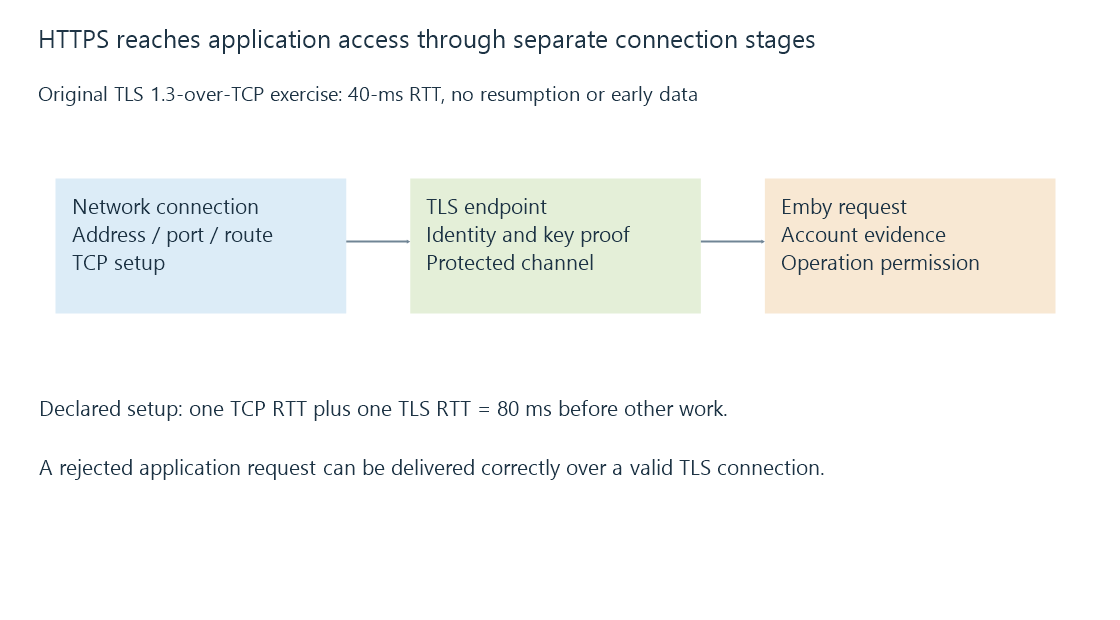
HTTPS uses TLS to protect an HTTP connection and verify the intended peer, with routing, handshake validation and application login forming distinct stages.
A client can reach the server’s IP address and still fail before it receives an Emby login response. TCP established a connection, but TLS could not establish the intended protected peer relationship.
HTTPS carries HTTP through TLS. Its protection belongs to that particular connection between the client and the TLS endpoint.
The protected channel has several properties
TLS negotiates cryptographic parameters and establishes traffic keys. Its protected records provide confidentiality and integrity for the application bytes carried through the channel.
In the usual certificate-authenticated server case, the endpoint also proves control of the relevant private key. The client checks the certificate’s path, intended use and requested service identity according to its validation rules.
Those checks make encryption meaningful for the service the app intended to reach. Exchanging encrypted records with an arbitrary unverified endpoint is a different result.
The port number participates in service selection. Calling a listener 443 or 8920 does not make a plaintext service perform TLS.
Public certificate and connection keys have different roles
The certificate supplies public-key and identity information signed by its issuer. It is not the private key itself.
TLS 1.3 normally derives traffic secrets through its handshake, including ephemeral key agreement in the common certificate-based case. Bulk application records then use the negotiated symmetric protection.
The certificate key helps authenticate the handshake. It is not a rule that every movie byte is encrypted directly with the certificate’s public key.
A public certificate can therefore be inspected without revealing the server’s private key. Its validity still needs to be evaluated for the actual connection.
Setup delay includes protocol round trips
Use an original simplified timing exercise:
{
  "roundTripMs": 40,
  "tcpSetupRoundTrips": 1,
  "tls13SetupRoundTrips": 1,
  "resumption": false,
  "earlyData": false
}
Under these stated assumptions, TCP setup takes forty ms and the TLS 1.3 setup phase another forty. The modeled client reaches its application-request point after eighty ms.
DNS, loss/retransmission, certificate processing and media startup are excluded. TLS can also use other handshake paths, and HTTP/3 has its own QUIC integration.
The arithmetic explains why a high-throughput connection can still have measurable setup time. It is not a benchmark or a universal delay added to every segment during an already established connection.
Certificate identity follows the requested service
A client using media.example.net checks the appropriate certificate name for that request. Resolving the name to a private or public IP does not automatically change its requested DNS identity.
Connecting directly to an IP literal instead asks for the corresponding IP identity. Certificate hostnames develops the matching rules.
An unexpired certificate can still have the wrong name, an unsuitable usage or no trusted path. The failure is more specific than “HTTPS is broken.”
Emby authentication is a later operation
TLS server authentication identifies the protected service endpoint. Emby’s user authentication identifies the account making the later application request.
A valid HTTPS connection can deliver a rejected login or access-denied response correctly. Conversely, a blocked TLS handshake never reaches that application decision.
Emby can terminate TLS itself through its configured secure listener, or a reverse proxy can provide the public TLS endpoint. TLS termination identifies which connection leg is protected in each arrangement.
See Also
- TLS certificates, public keys and endpoint evidence
- Certificate hostnames and the requested service identity
- TLS termination and independent connection legs
- Mixed content and a browser’s secure-page boundary