Media identification
Media identification associates a local resource with the intended work or catalogue entity using content context, search evidence and scoped identifiers.
Identification connects a local media resource to an intended entity. For a film, that may be a catalogue's movie record. For music, a recording and an issued album release can require different identities.
The encoded file's checksum identifies its byte content under that checksum algorithm. It does not, by itself, identify the film title in a provider's catalogue.
Generate candidates, then assess the match
Consider an invented filename suggesting The Station, 2020, in a movie library. A title search returns:
| Candidate | Title | Year | Entity type |
|---|---|---|---|
| A | The Station | 2020 | Film |
| B | The Station | 2020 | Television series |
| C | The Station | 1982 | Film |
Title wording alone cannot choose among them. Year and media-type context support A in this example.
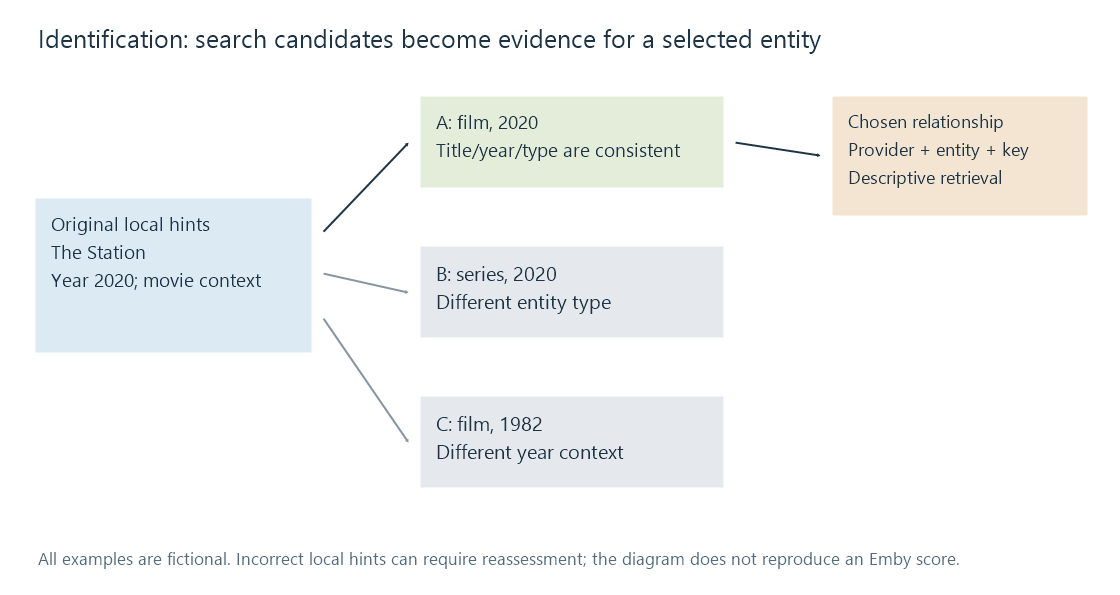
A search result is a candidate, not a completed identification. After selection, a scoped provider identifier can retain the chosen relationship while descriptions and artwork are obtained.
If the filename's year is wrong, a rigid exact-year rule can reject the intended work. Matching evidence needs an appropriate interpretation rather than an assumption that every local label is authoritative.
More specific clues can resolve ambiguity
For episodes, the series identity and ordering context matter alongside a number in the filename. For music, artist, track listing, release information and supported acoustic fingerprints can supply other evidence.
Title disambiguation develops name/date clues. Provider identifiers explain the namespace and entity relationship of the chosen key.
The algorithm and confidence policy belong to the implementation. The example above is an evidence comparison, not a reconstruction of Emby's internal matching score.
Work identity does not describe every representation
A standard and extended film edit can share a catalogue work identity while having different timelines. A dubbed encode can add another audio presentation. Technical probing describes the actual streams; it should not be replaced with properties guessed from the work's provider page.
In music, one recording can appear on several releases with different track positions or artwork. A recording match alone therefore does not establish an album edition.
The appropriate identity level depends on the action: finding a synopsis, choosing release artwork and aligning subtitles can require different additional evidence.
No public match is a valid outcome
A personal home video may have no commercial catalogue record. It can still have a local title, date, description and technical properties.
For Emby, library context, naming guidance and Metadata Manager provide the documented identification/editing workflow.
See Also
- Title disambiguation
- Provider identifiers
- Acoustic fingerprinting
- Conflicting metadata
- Technical media metadata