DVB-S satellite television
DVB-S defines a satellite transmission system using QPSK and specified framing/error-protection relationships before programme services are recovered.
DVB-S specifies a digital satellite transmission arrangement. It uses QPSK with its defined channel coding and framing to carry recoverable data through the satellite link.
The programme selected by an Emby viewer is contained in that recovered data, not defined by the modulation name.
Four symbol alternatives
QPSK has four phase alternatives in its symbol alphabet. Four labels need two bits because 2² = 4.
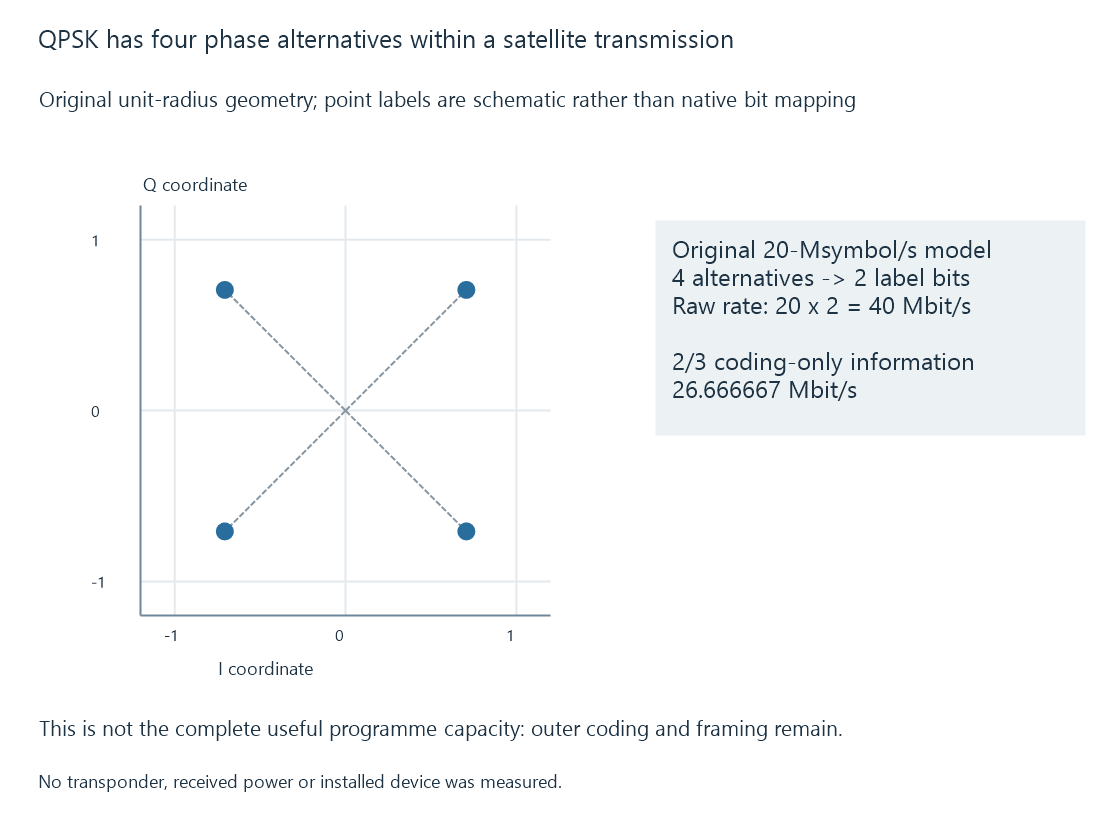
The diagram concerns symbol alternatives. It does not depict four television programmes, four tuners or a complete channel’s useful bitrate.
Symbol rate and information rate differ
For an original twenty-million-symbol/second exercise:
Raw point-label rate = 20,000,000 × 2 = 40,000,000 bits/s
If a declared inner coding relationship has information fraction two-thirds, its coding-only information ceiling is:
40,000,000 × 2/3 = 26,666,667 bits/s, approximately
Outer error protection, framing and other structure still require accounting. The second value is not a complete DVB-S programme-capacity calculation.
A more redundant coding arrangement gives some transmitted work to protection rather than new information. The usefulness of that tradeoff depends on the received channel and receiver.
The transponder needs a complete tuning description
Frequency, input route, polarization and symbol/configuration information identify the required acquisition. A frequency alone can be insufficient if another needed parameter or upstream input state is wrong.
Satellite reception explains downconversion and shared-input constraints.
Several services can share a recovered transponder transport. Later programme and component selection determines which media Emby receives.
DVB-S2 changes the transmission/coding arrangement
DVB-S2 has a second-generation definition with additional modulation/coding relationships. It is not simply an instruction to decode the same DVB-S stream with HEVC.