ATSC PSIP: virtual channels, events and time
ATSC PSIP connects virtual-channel identity with event descriptions, table-discovery information and a GPS-based system clock in the ATSC 1.0 broadcast environment.
PSIP, the Program and System Information Protocol, helps an ATSC 1.0 receiver turn a physical broadcast into familiar virtual channels and programme descriptions.
A displayed number such as 7.1 is only one part of that relationship. The receiver also needs the source identity used by event tables, the programme selected for media and the timing context used to place events in the guide.
The channel number connects to two paths
The Virtual Channel Table, or VCT, describes virtual channels. Its programme association helps connect the channel to its media; its source_id connects it to guide events.
That makes it possible for the picture and schedule to fail independently. The media selection can work while the event association or clock interpretation is wrong.
Virtual channel numbers explains why 7.1 does not directly specify an RF frequency.
Table discovery precedes event interpretation
The Master Guide Table, or MGT, identifies relevant table types and their delivery locations. Event Information Tables, or EITs, carry scheduled events. Extended Text Tables can add longer descriptions. The System Time Table, or STT, supplies clock context.
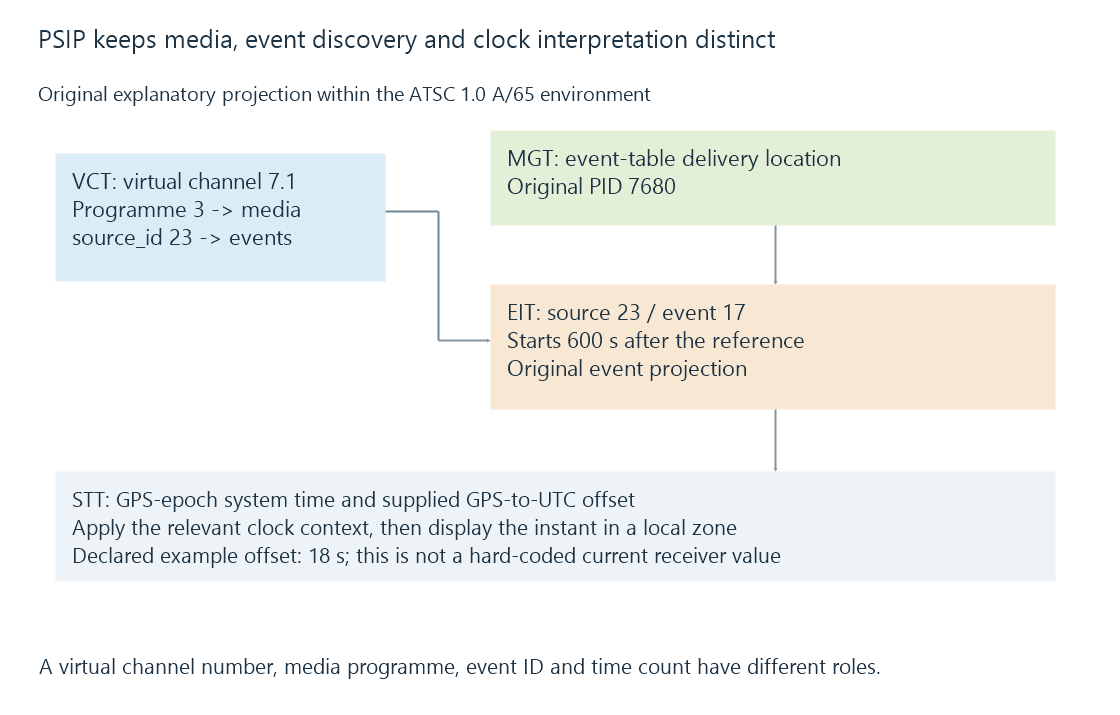
An original teaching projection combines a few of those relationships:
{
  "vct": {"major": 7, "minor": 1, "programNumber": 3, "sourceId": 23},
  "mgt": {"eventTablePid": 7680},
  "eit": {"sourceId": 23, "eventId": 17, "startsAfterReferenceSeconds": 600},
  "stt": {"referenceClock": "GPS", "gpsUtcOffsetSeconds": 18}
}
These simplified keys are explanatory rather than native A/65 field layouts. The EIT’s source 23 matches the VCT’s source 23. Programme three remains the separate media selection. The MGT location tells the receiver where to collect the event table; it is not the event’s episode identity.
The eighteen-second offset is a declared teaching value. A receiver uses the offset actually supplied by the relevant system-time context.
Event numbers have a scope
An ATSC event identifier belongs to its virtual-channel/event-table context. It does not become a global episode identifier merely because it is called an ID.
A repeat of the same television episode can be another airing. Another channel can also use an equal event number for unrelated content.
Matching a future recording therefore needs the relevant channel, event/time context and the application’s translated identity. Programme identifiers distinguishes those airings from episode and series identities.
Table revision markers are scoped too. A/65’s guidance specifically warns against treating the MGT’s EIT/ETT version information as a simple version for a time slot without retaining the table delivery context.
GPS seconds are not Unix seconds
PSIP’s system and event start counts use the GPS epoch of 6 January 1980. Unix time has another epoch. Interpreting one count as the other produces a large date error before local time zones enter the calculation.
The GPS-to-UTC offset must also be applied. Only then can the resulting instant be displayed in a chosen local zone.
An event six hundred seconds after the system-time reference is ten minutes later on the same interpreted clock. That relative difference survives a common offset correction. Giving the absolute event a local display time additionally requires the correct epoch and conversion.
Guide time zones develops local clock changes; those are separate from the GPS/UTC distinction. This PSIP explanation concerns A/65 in the ATSC 1.0 environment. ATSC 3.0 uses its own signaling system.
See Also
- ATSC 1.0 broadcast television
- Virtual channel numbers
- Programme identifiers: airings, episodes and series
- Guide time zones and clock changes