Compilation albums
A compilation album brings selected recordings into one release whose shared album context differs from the performer credits of individual tracks.
A compilation selects recordings into an issued album. The performers can change from track to track while the release remains one product.
These three track occurrences are an excerpt from the fictional Evening Selection:
| Track | Track artist | Album | Album artist |
|---|---|---|---|
| 7, River Lights | Mira Vale | Evening Selection | Various Artists |
| 8, Signal | Ivo Reed | Evening Selection | Various Artists |
| 9, Last Ferry | Harbour Quartet | Evening Selection | Various Artists |
Various Artists is the album-level credit chosen in this example. It is not the performer who sang or played every track.
How the album can split
Suppose the first two files instead copy their performers into the album-artist field. A grouping model using album title and album artist sees three different contexts, despite the shared directory and album name.
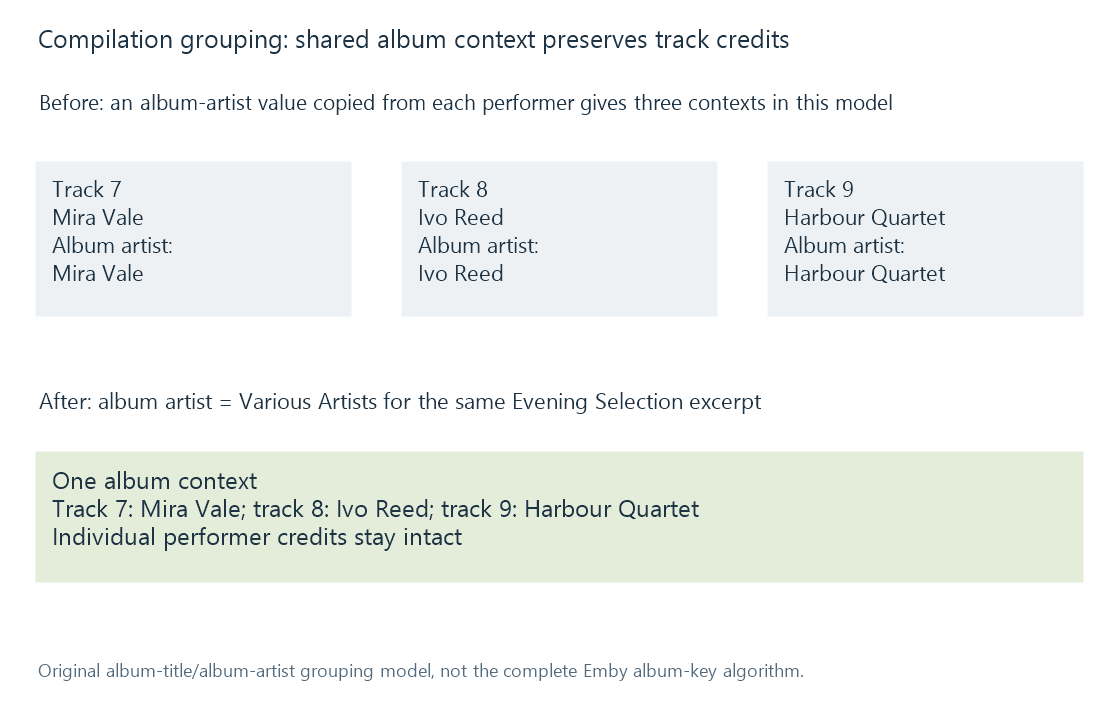
The diagram is a simple explanatory model, not Emby's complete album-key algorithm. Emby's music documentation does establish the relevance of consistent album and album-artist fields to compilation grouping.
Changing all track artists to Various Artists would make those labels consistent at the wrong scope. It discards useful information about who performs Signal and Last Ferry. The album-artist field supplies the shared context without replacing those credits.
Compilation is a role, not an identifier
A compilation flag can tell a reader or tagger that an album has compilation status. It does not identify the particular release product, nor resolve conflicting album IDs.
A compilation can also feature only one primary artist—for example, a collection of recordings previously issued by that artist. “Several artists” and “compilation” are overlapping concepts, not exact synonyms.
The recordings themselves can keep their original identities. The River Lights studio audio may also occur on Harbour Songs. Its occurrence on Evening Selection has another track number, album context and cover without requiring a new recording merely because it was selected again.
Keep the product's sequence
A compilation's sequencing can be intentional. Sorting by performer rearranges the programme; sorting by its release track positions preserves the issued sequence.
If the product spans two discs, the disc and track pair identifies that position. Album identity, album-level credit and the ordered occurrences together describe the compilation, while the track credits continue to describe its contributors.
See Also
- Album artists and track artists
- Music recordings and track occurrences
- Music releases and album editions