Multi-disc albums
A multi-disc album uses disc and track coordinates to organize several media within one release without turning each disc into an unrelated album.
A two-disc release normally restarts track numbering on its second disc. The two track 1 values are not duplicates: their coordinates are disc 1, track 1 and disc 2, track 1.
The disc coordinate qualifies the track coordinate, just as a season qualifies an episode number.
Sorting the pair
In this separate original five-track product, disc 1 has three tracks and disc 2 has two:
| Product position | Disc | Track |
|---|---|---|
| 1 | 1 | 1 |
| 2 | 1 | 2 |
| 3 | 1 | 3 |
| 4 | 2 | 1 |
| 5 | 2 | 2 |
Sorting by track number alone can interleave the discs: 1/1, 2/1, 1/2, 2/2, 1/3. Sorting by disc and then track preserves the product sequence.
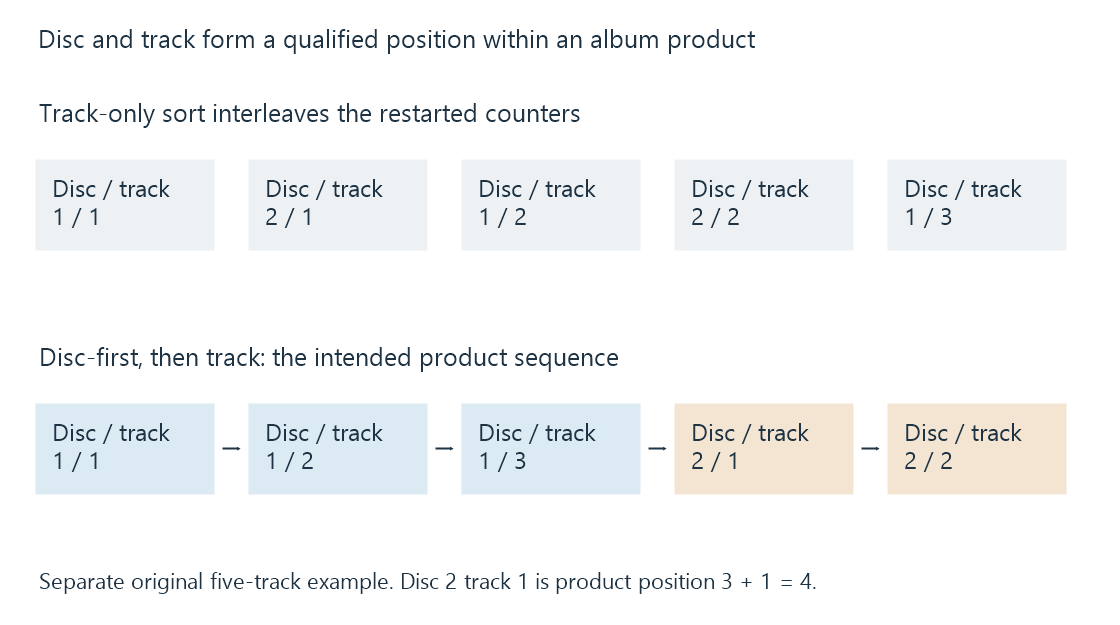
For disc 2 track 1, the product position is 3 + 1 = 4 because three tracks precede that disc. That flattened position is derived from this particular product's track counts; it is not a universal replacement for the disc/track pair.
Disc position and total are different values
Common tag mappings include ID3 TPOS for part-of-set and TRCK for track position, or Vorbis DISCNUMBER and TRACKNUMBER. Tagging conventions can also retain total-disc and total-track information.
A value such as 2/2 in a part-of-set field means disc 2 of a two-disc set. It does not mean “two tracks,” and the track total for disc 2 can differ from the total for disc 1.
The tag format and tagging software determine how these values are encoded. Emby's music library reads the embedded information; naming a folder Disc 2 is storage evidence, not a substitute for consistently represented album and position fields.
One release can own several media
A common album title and album-level credit can remain the same across both discs. The disc coordinate then distinguishes their positions within the release.
Appending Disc 2 to the album title can deliberately create a separate presentation, but it also changes the album label. If the intended model is one product, that distinction is better carried by the medium coordinate.
Product identity still matters when a single-disc original and a two-disc expanded edition share a title. Disc numbers distinguish the media within an edition; they do not, by themselves, distinguish the editions.
The music can cross the packaging boundary
A long work can continue across a disc change. A continuous concert can be divided into several tracks. The medium boundary and the composition boundary need not coincide.
Gapless playback concerns the transition between the encoded resources. Disc/track metadata concerns ordering. Correct numbering can deliver the intended next track without proving that decoder delay and padding were handled correctly at the boundary. Gapless playback explains that separate mechanism.
See Also
- Music releases and album editions
- Album artists and track artists
- Gapless playback
- Audiobook chapter structure