NVIDIA Blackwell media capabilities
Blackwell’s documented media additions include H.264/HEVC 4:2:2 paths and H.264 ten-bit features, with exact product resources and SDK/driver exposure defining the usable configuration.
Blackwell's documented NVIDIA media additions include H.264 and HEVC 4:2:2 encoding/decoding paths and ten-bit H.264 features. These are specific format changes, beyond another entry for ordinary eight-bit 4:2:0 video.
NVIDIA introduced these capabilities in its SDK 13.0 Blackwell material. The current SDK and product matrix establish their updated software and device scope.
Chroma and precision are separate dimensions
A 4:2:2 picture retains chroma at a different spatial sampling relationship from 4:2:0. Ten-bit storage precision is another property.
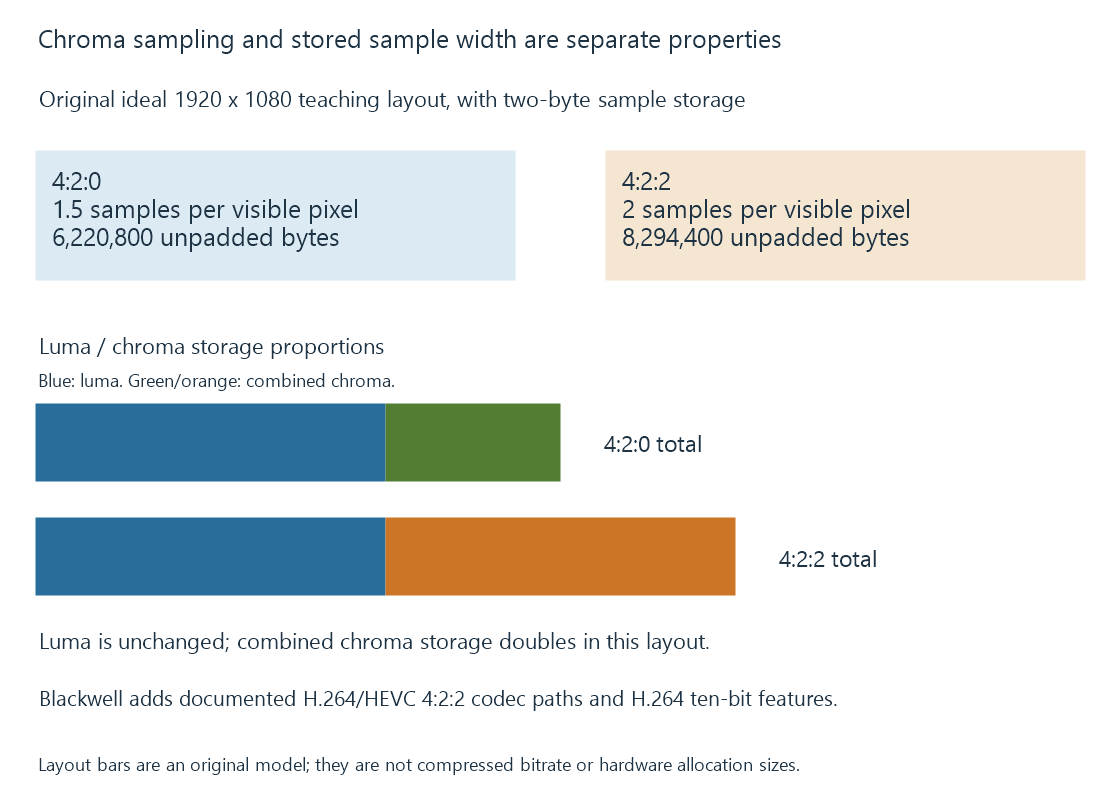
For an original ideal 1920 × 1080 picture, 4:2:0 has 1.5 samples per pixel across its planes, while 4:2:2 has two. If each sample occupies two bytes of storage:
4:2:0 = 1920 × 1080 × 1.5 × 2 = 6,220,800 bytes
4:2:2 = 1920 × 1080 × 2   × 2 = 8,294,400 bytes
The calculation concerns ideal unpadded picture storage. It does not give a compressed bitrate.
NVIDIA's Blackwell material names NV16 and P210 among its semiplanar encoder input formats for the relevant 4:2:2 paths.
A product row defines its resource count
The GeForce RTX 5090 matrix lists three ninth-generation NVENC units and two sixth-generation NVDEC units.
Those are different operation resources. The same row includes its 4:2:2 encoding columns and AV1 encode/decode entries.
A Blackwell architecture label is not a rule that every product must contain those same counts. The exact selected row remains part of the evidence.
Source and target profiles need software exposure
A new device feature needs an application wrapper, SDK/runtime and driver path that expose the requested profile and picture format.
A program compiled with an older interface can therefore fail to offer a configuration present in the hardware reference. Its accepted input-surface layout is also another required link.
For an Emby source using ten-bit 4:2:2, the server's actual decoder, filters and target encoder establish the executing route. The feature addition is relevant to the source query, while the observed initialization supplies the implemented answer.
Keep the pipeline’s picture work explicit
Scaling, colour interpretation, subtitle composition and output packaging remain separate operations. An accepted 4:2:2 decoder does not choose those transformations automatically.
The format and resource relationships described by frame surfaces connect the new codec configurations to their consumers.
See Also
- NVIDIA Ada Lovelace media capabilities
- NVIDIA NVDEC
- NVIDIA NVENC
- How to read a hardware codec support matrix
- Driver-dependent media capabilities