Intel Kaby Lake media capabilities
Kaby Lake’s media capabilities provide important AVC and ten-bit HEVC decoding paths, with encoding classifications and exposed features dependent on the documented software implementation.
Kaby Lake is an important Intel generation for reconstructing mainstream HEVC Main 10 video. The supported integrated media path can decode the ten-bit source pictures needed by many HDR files.
Decoding those pictures and preparing an SDR output are separate work. The latter still needs the selected tone-mapping and other picture operations.
Use the KBLx column with its legend
Intel Media Driver groups Kaby Lake with related platforms in its KBLx column. These selected entries come from the pinned implementation snapshot:
| Configuration row | Full-Feature build | Free-Kernel build |
|---|---|---|
| AVC | D/E/Es | D/E |
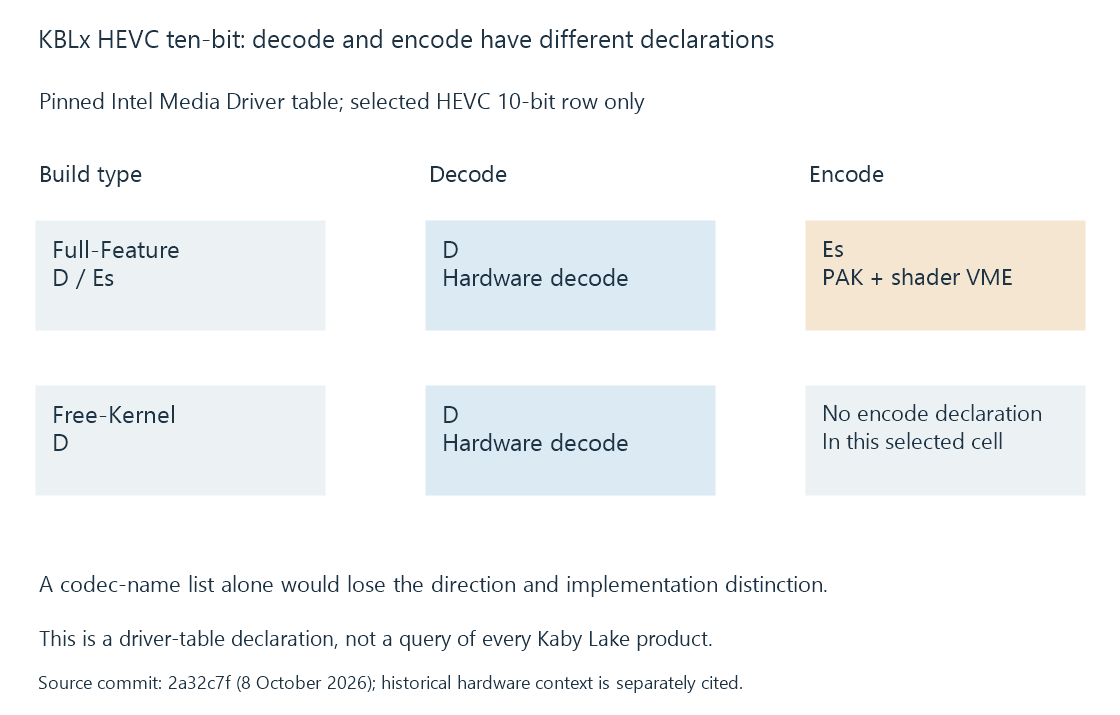
| HEVC 10-bit | D/Es | D |
| VP9 10-bit | D | D |
| AV1 10-bit | Not listed | Not listed |
D identifies decoding, E the source's hardware/low-power encoding path, and Es hardware-plus-shader encoding.
Intel's separate 2024 hardware reference likewise classifies the 7th/8th-generation HEVC encoder under its hardware-plus-shader row. Describing every listed HEVC operation as one pure fixed-function path would erase that distinction.
A ten-bit HDR input needs a complete picture route
Imagine an Emby conversion taking HEVC Main 10 input and delivering an 8-bit H.264 SDR target.
The selected source decoder is one requirement. The picture route needs the intended HDR-to-SDR relationship, output dimensions and selected subtitle handling before the target encoder receives its pictures.
Main 10 decode support does not apply those transformations automatically. A software or device-based filter choice determines the actual intermediate path and its frame access.
The processor SKU must provide the media resource
A processor product without enabled processor graphics does not supply this integrated media path merely because its CPU architecture belongs to the generation. Another discrete adapter is a separately identified resource.
The installed runtime/driver and application need a usable route to the selected device. An older Media SDK description and a current driver matrix have their respective implementation scopes.
Retain the operation that matters to the session
For Kaby Lake source compatibility, HEVC Main 10 decode and AV1 decode are different questions. The selected table declares the former and does not list the latter.
For output, the AVC and HEVC rows have different classifications. Choosing the actual target codec and implementation therefore changes the route being assessed, even with the same source file.
See Also
- Intel Quick Sync Video (QSV)
- Intel VPL and the oneVPL name
- Intel Elkhart Lake and Jasper Lake media capabilities
- How to read a hardware codec support matrix
- Mixed hardware and software filtering
- How HDR-to-SDR Tone Mapping Works