Media server APIs and programmable operations
A media server API exposes documented operations and data so another program can query or control supported server behavior.
A media server API lets software request operations from the server: query a library, inspect sessions or invoke a supported action. The server receives a structured request and returns a result under the operation's documented contract.
An Emby app uses such operations to build its interface. An external integration can use documented operations for its own workflow without reproducing the app's entire screen.
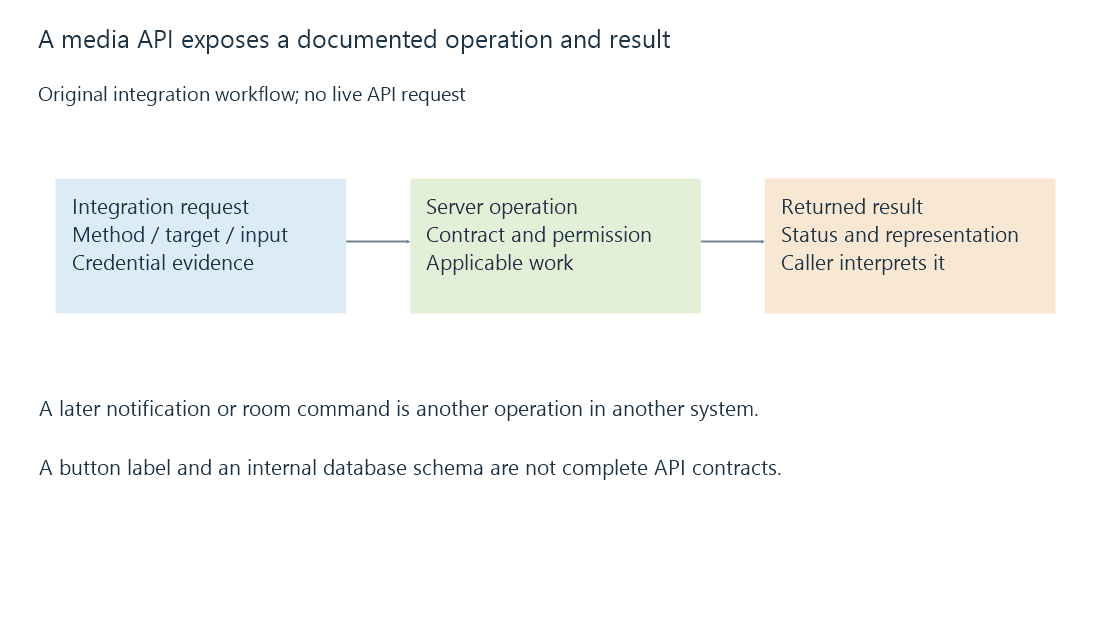
The contract makes the operation interpretable
| Contract detail | What the caller needs to know |
|---|---|
| Endpoint and method | Which operation is requested |
| Parameters and body | What inputs the operation accepts |
| Authentication and policy | Which identity can request it |
| Response fields and status | How the result is represented |
| Version behavior | Which documented combination is supported |
A visible button is a user-interface affordance, not a complete API contract. The operation behind it may need identity, fields or a sequence that is absent from the button's label.
Likewise, a JSON response is a public representation. It does not specify which internal database table stores the information.
The integration owns the next step
A library query returns information for the caller to interpret. If the caller then sends a notification, that notification is another operation in another system.
A state-changing API request can also have an uncertain result when its response is lost. The caller needs the documented operation semantics to decide whether checking state or retrying is appropriate.
For a small integration, first identify the supported operation and the specific result it needs. Authentication, pagination and delivery behavior then have concrete roles rather than being incidental connection settings.
Emby's library-browsing contract is an example of a documented starting point. Plugin architecture describes a different arrangement where extension code participates inside the server process.
See Also
- HTTP API requests and interpretable responses
- API authentication tokens and request identity
- Integration permissions and effective operations