Variable Bitrate Video Encoding
Variable bitrate encoding allows the coded video rate to change as the content and encoding constraints require.
The variable-rate allocation in this figure uses 2, 3, 6, 7, 2, 3, 5 and 4 Mb/s across eight one-second intervals.
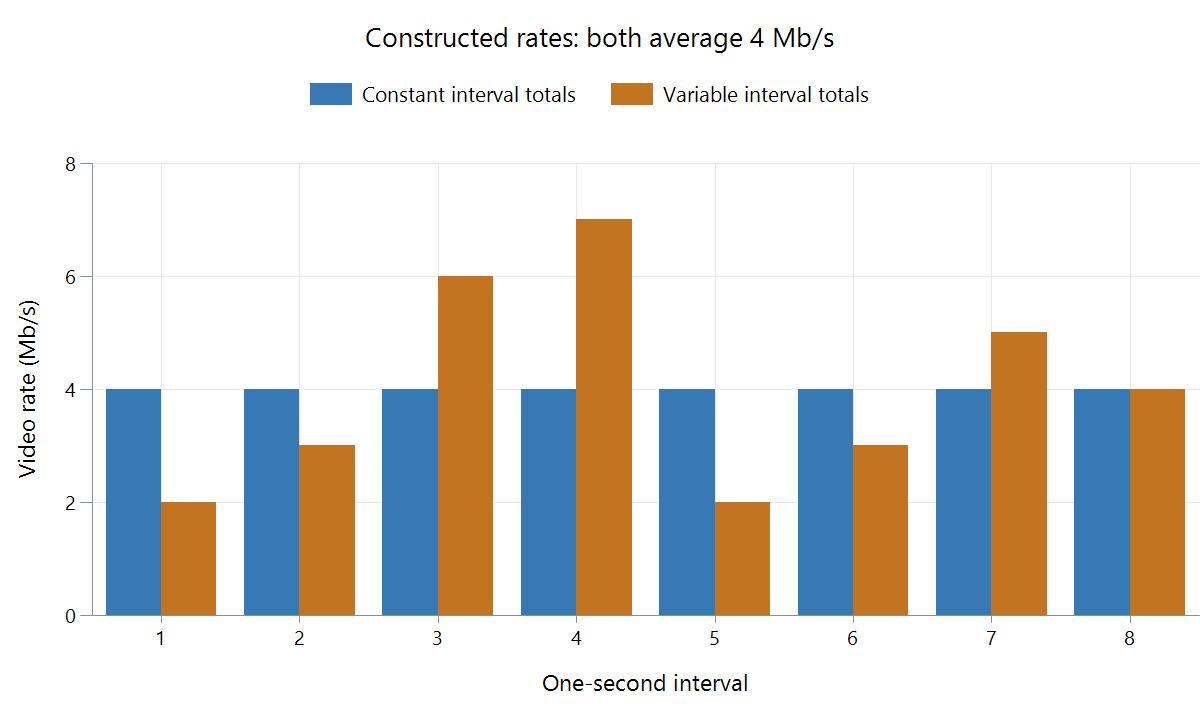
Original allocation example, not encoder measurements. Each column represents one media second.
The total is 32 megabits, giving an average of 32/8 =4 Mb/s. An equal 4 Mb/s allocation also contains 32 megabits. The two have the same total data, distributed differently through time.
Variable bitrate (VBR) permits that changing allocation. Simple content can use less data and difficult content more, under the encoder's selected overall or local constraints.
Supply the plotted sequence
Use a simplified delivery model: the connection supplies 4 megabits per second continuously, and the video consumes each plotted interval's amount evenly within that second. Begin with 2 megabits already buffered.
| Interval | Video demand | Supplied | Buffer at interval end |
|---|---|---|---|
| 1 | 2 Mb | 4 Mb | 4 Mb |
| 2 | 3 Mb | 4 Mb | 5 Mb |
| 3 | 6 Mb | 4 Mb | 3 Mb |
| 4 | 7 Mb | 4 Mb | 0 Mb |
| 5 | 2 Mb | 4 Mb | 2 Mb |
| 6 | 3 Mb | 4 Mb | 3 Mb |
| 7 | 5 Mb | 4 Mb | 2 Mb |
| 8 | 4 Mb | 4 Mb | 2 Mb |
The quiet first two intervals build supply for the demanding third and fourth. With an empty initial buffer, the same accounting would fall 2 megabits below zero by the end of interval 4. Matching the average rate would not be enough to start this simplified sequence without advance data.
The assumptions deliberately isolate the arithmetic. Real frame removals, request timing, overhead and network interruptions require their own scheduling; this is not a decoder-buffer conformance test.
A seek beginning near interval 4 also starts with a different buffer state. Earlier quiet content cannot supply a surplus unless it was actually fetched for that playback start.
Two objectives can produce variable output
An average-budget encode tries to fit the complete video into an overall amount of data. It can transfer allocation from easier sections to harder ones. Two-pass analysis provides additional knowledge of where those sections occur.
A quality-led encode allows the size to follow the source at a chosen quality policy. The final average can be different for two films, or for a clean and grainy version of the same scene. CRF is one implementation of that kind of control.
Both produce variable rates, but they are solving different optimization problems. “VBR” by itself does not identify which objective was used.
Add a local limit deliberately
A whole-film data budget says little about a short burst's deadline. A maximum-rate/buffer constraint adds local delivery requirements. The encoder may need to accept a less detailed picture when a difficult section reaches those limits.
In an Emby session, original delivery retains the source's local variation; a video transcode creates another allocation with its own constraints. The plotted calculation shows which parts of that rate description explain total size, and which explain the supply needed during playback.
See Also
- Constant Bitrate Video Encoding
- Constant Rate Factor (CRF) for Video
- Two-Pass Video Encoding
- Bitrate Variation