ITU-R BT.2020
ITU-R BT.2020 defines UHD television parameters and a wide set of color primaries.
BT.2020 defines a set of wide-gamut RGB primaries for UHD television. Their coordinates identify the colors from which mixtures are formed:
| Primary | CIE 1931 x | CIE 1931 y |
|---|---|---|
| Red | 0.708 | 0.292 |
| Green | 0.170 | 0.797 |
| Blue | 0.131 | 0.046 |
| Reference white, D65 | 0.3127 | 0.3290 |
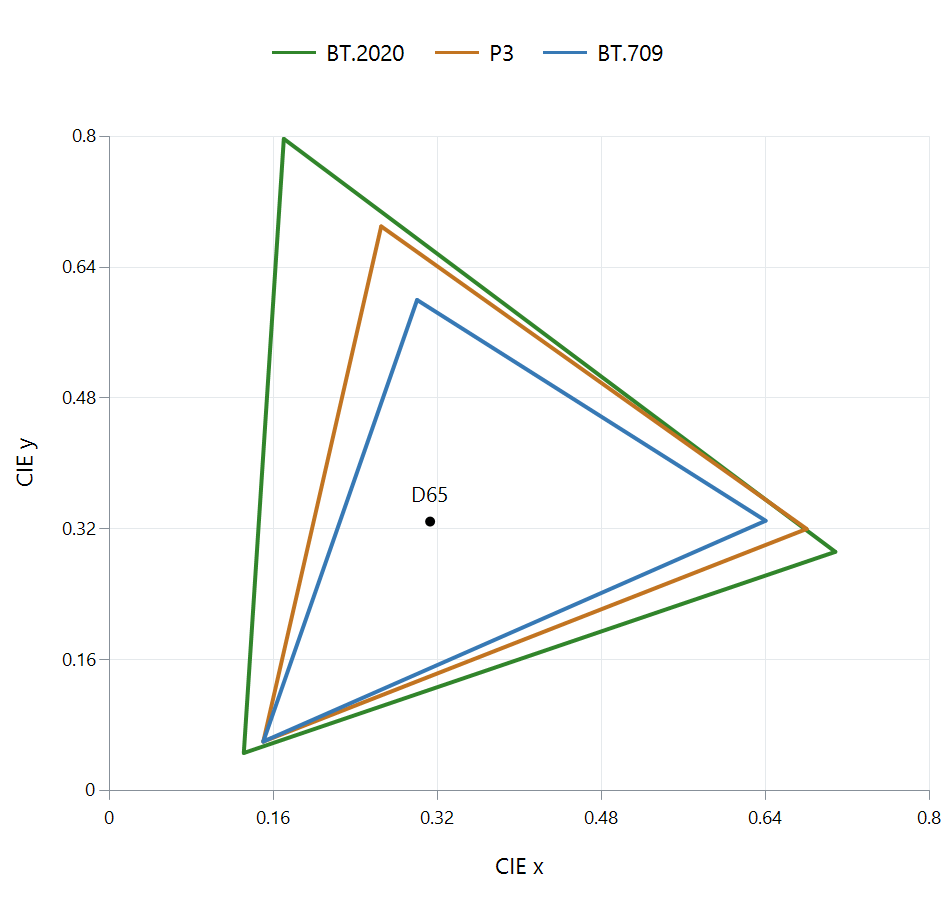
Coordinates show the encoding gamut. The diagram omits luminance; its line colors identify the triangles.
An encoding space can be larger than the colors in the movie
Suppose a film is graded with colors that fit in P3, then represented with BT.2020 coordinates for delivery. The converter finds BT.2020 RGB mixtures for those existing colors. The film does not acquire more saturated objects simply because the available coordinate space grew.
This is similar to choosing a larger map for a journey: the map has room for more places, while the route still visits its actual locations. In video, the important operation is converting coordinates correctly. Reusing P3 numbers and merely changing the primary label would describe different colors.
The standard also defines UHD image sizes of 3840 × 2160 and 7680 × 4320 and 10- or 12-bit signal precision. The color-primary label in a media report identifies only the primary-coordinate part of that system. A renderer still needs the rest of the signal description.
Transfer, matrix, range, and precision fields
Transfer characteristics: BT.2020 includes a conventional nonlinear transfer characteristic. HDR television systems in BT.2100 reuse these primaries with PQ or HLG. Consequently, the transfer field tells a player which light interpretation applies.
Matrix coefficients: The standard defines constant-luminance and non-constant-luminance component representations. A report of BT.2020 non-constant describes the nonlinear RGB-to-luma/chroma arrangement; it is not another set of primaries. Reconstructing RGB needs the corresponding matrix interpretation.
Range and precision: These establish how code values carry the signal. Ten bits give the number of levels; numerical range establishes the code positions for nominal black and white. Neither replaces the transfer characteristic.
For an Emby source with BT.2020 primaries and PQ, the playback path needs the PQ interpretation, then appropriate rendering for the output display. A BT.2020 SDR signal follows a different light relationship. Comparing the fields together lets two apparently similar 4K files be distinguished before choosing color or tone-mapping processing.