CUDA subtitle overlay
CUDA subtitle composition blends accepted device video/image formats and remains distinct from text rendering, codec engines and the selected Emby graph.
CUDA can execute a subtitle-image blend on NVIDIA device data. That composition step is distinct from rendering the text and from the dedicated video decode/encode stages.
The inputs must satisfy the specific filter's format contract. A generic claim that a GPU supports CUDA is not enough to establish that a chosen subtitle canvas can be composed with the selected video surface.
The examined filter has a limited format set
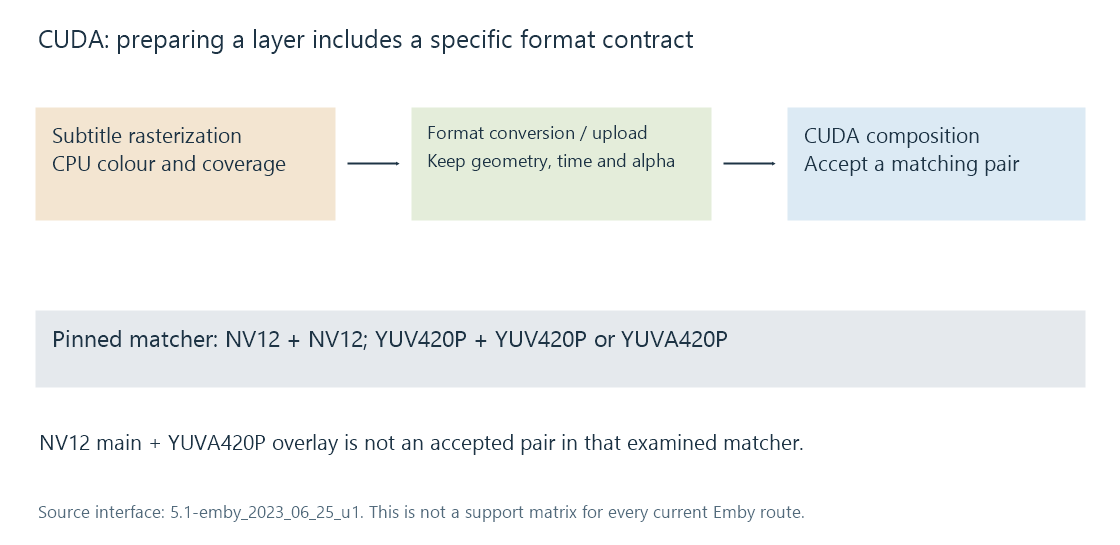
In Emby FFmpeg 5.1-emby_2023_06_25_u1, the overlay_cuda format-matching code accepts these pairs:
| Main software format underlying the CUDA frames | Accepted overlay format |
|---|---|
| NV12 | NV12 |
| YUV420P | YUV420P or YUVA420P |
The overlay format list includes YUVA420P's alpha plane, but the matching code does not pair it with an NV12 main input. It also does not make an arbitrary RGBA, 10-bit P010 or another surface acceptable.
This is a source-verified table for that dated filter, not a current support table for all Emby CUDA routes.
The layer needs conversion without losing its meaning
A text renderer can produce coverage and colour on CPU memory. A route preparing CUDA input must select a compatible representation, preserve alpha where supported, upload/map it appropriately and retain its timing.
Dropping alpha can change transparent background into an opaque rectangle. Choosing another format can also change range, colour or chroma sampling. Those are conversion decisions before the kernel does the blend.
Kernel and codec work occupy different stages
CUDA kernels operate on device memory. A hardware encoder consumes picture surfaces through its applicable codec interface. A session can use one stage without placing every preceding task on that same engine.
The kernel needs correctly synchronized inputs and produces an output whose completion the next stage observes. Image pitch and per-plane dimensions matter alongside the visible width/height.
For Emby, the hardware overview, actual binary capabilities and selected graph describe the available combination. The reference source proves the table's interface; it does not prove that a session used it.