CPU cores, threads and concurrent workloads
CPU concurrency distributes runnable work across available execution resources, with serial dependencies and shared limits preventing simple multiplication by thread count.
A media server can have several kinds of work active at once: requests, scans, metadata processing and software encoding. Operating-system threads let that work be scheduled concurrently, but a thread is not a reserved processor.
Physical cores, logical processors and application threads describe different layers.
Two threads can share one physical core
Some processors expose multiple logical processors per physical core. Those logical processors share execution resources, so they do not behave like an equal number of independent full cores. Other processors use different core types with different capabilities.
A process with twenty runnable threads on four available execution contexts still needs the scheduler to alternate or distribute that work. Threads waiting for storage are not demanding CPU continuously.
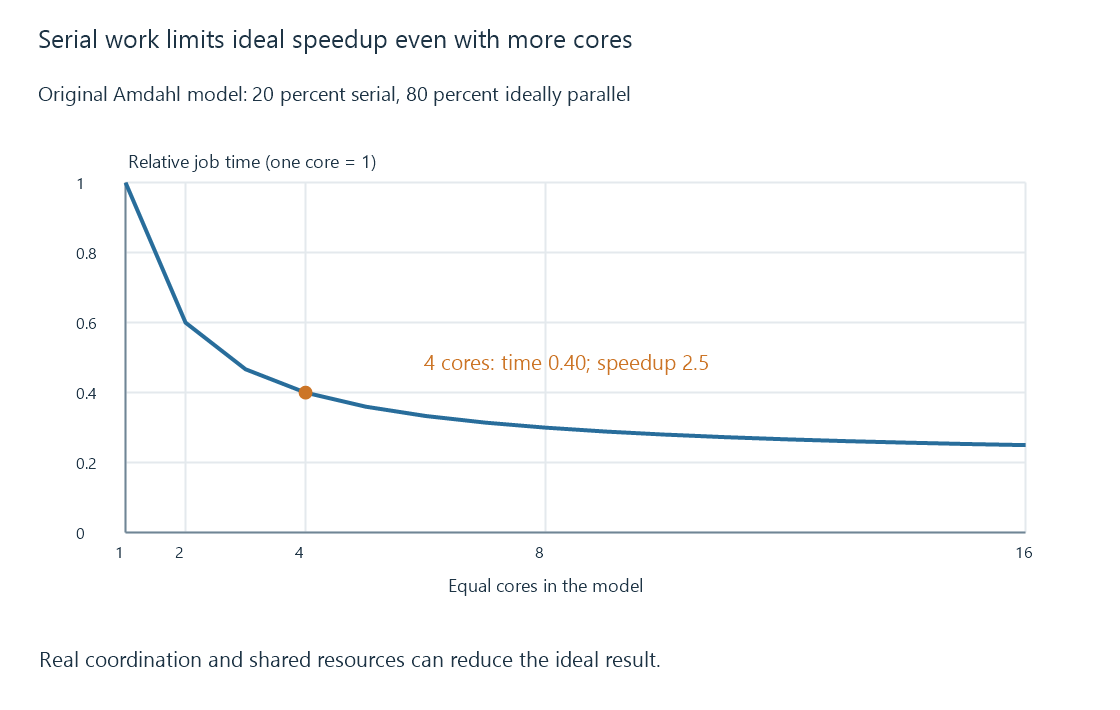
Serial work limits parallel speedup
Suppose a fictional job spends 20% of its original time in unavoidable serial work and 80% in ideally parallel work. With four equal cores:
Ideal relative time = 0.20 + 0.80 / 4 = 0.40
Ideal speedup = 1 / 0.40 = 2.5
Even the ideal model does not give a fourfold improvement. With infinitely many cores, its serial fraction limits speedup to five. Real coordination, unequal cores and memory competition can reduce the result further.
An encoder may have frame dependencies, stage dependencies or a finite amount of parallel work. Increasing its worker count cannot remove those relationships.
Several real-time jobs share a budget
For a simple model, four equal cores provide at most four core-seconds during one wall-clock second. If each fictional stream requires 1.5 core-seconds per second of presentation, three streams demand 4.5—before other server work.
That does not prove a real stream uses that amount. It explains why individually successful jobs can miss deadlines when combined.
| Observation | Possible implication |
|---|---|
| One stream succeeds; several fall behind | Aggregate demand or another shared resource exceeds supply |
| Low total CPU use with one busy thread | Serial work or a limited parallel stage |
| Many threads but little progress | Waiting, contention or quota can be involved |
| Hardware encoding active | CPU still handles other pipeline and server work |
A container quota can reduce the available aggregate time without changing the host's physical core count. Memory and storage bottlenecks can instead leave processors waiting.
For Emby, relate CPU evidence to real-time transcoding and the actual concurrent workload. Processor utilization is an observation of scheduled work, not a complete explanation of where a media pipeline lost time.
See Also
- Real-time transcoding and playback deadlines
- Container CPU and memory limits
- Thermal throttling and sustained server throughput