Network jitter and changing packet delay
Network jitter is variation in packet delay under a specified metric, with reordering and deadline effects determined by the actual timing sequence.
Equal-spaced sends need not arrive equally spaced. Waiting, contention and path behavior can change the delay from packet to packet.
The word jitter needs a stated metric. Packet-delay variation, arrival-spacing variation and a tool’s smoothed estimator are not interchangeable numbers.
Calculate delay before its variation
Use this original common-clock trace:
{
  "sendMs": [0, 20, 40, 60],
  "arrivalMs": [20, 45, 95, 87]
}
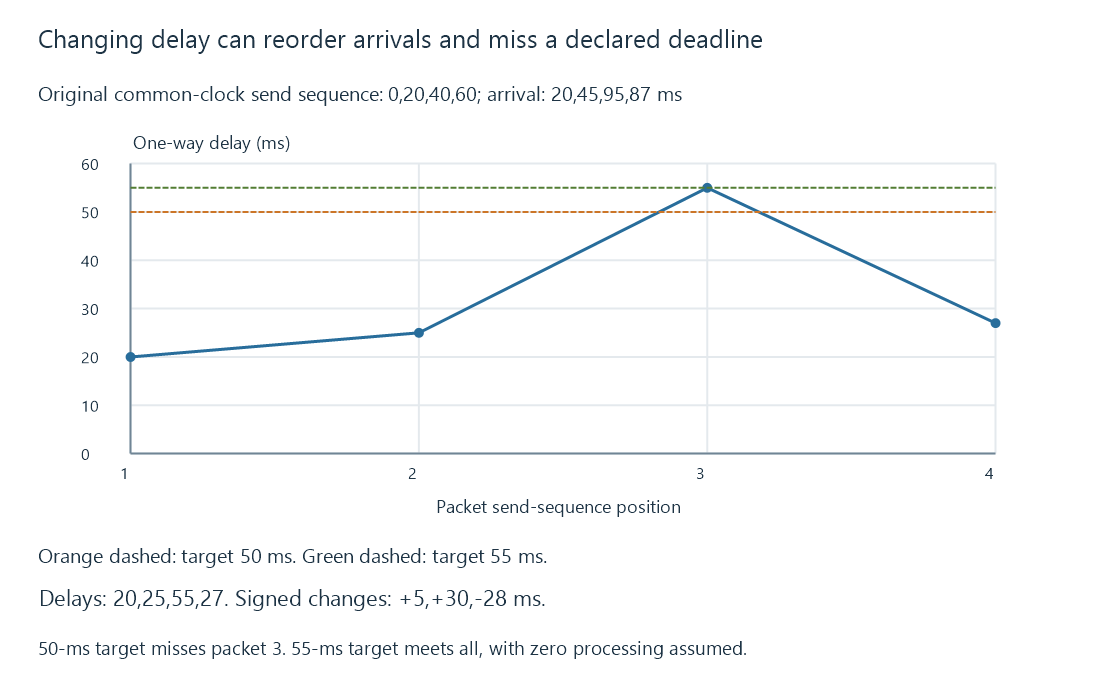
The one-way delays in send-sequence order are twenty, twenty-five, fifty-five and twenty-seven ms.
Consecutive signed delay differences are +5, +30 and -28 ms. Under this exercise’s chosen mean-absolute-difference statistic, the result is twenty-one ms.
That twenty-one-ms figure does not assert every tool called “jitter” would report the same statistic.
Changing delay can reverse arrival order
Packet three is sent at forty and arrives at ninety-five. Packet four is sent later, at sixty, but arrives earlier at eighty-seven.
Reordering therefore occurs without either packet being absent. An ordered transport can retain the later sequence data until the earlier missing position arrives.
Packet loss describes another observation; a late packet needs a defined threshold before it is counted as lost by a particular measurement.
A larger target can absorb this declared variation
Suppose a reduced playout model needs each packet at its send time plus fifty ms, with no other processing.
The third deadline is ninety ms, but that packet arrives at ninety-five: five ms late. The other three pass their stated deadlines.
Using fifty-five ms instead gives deadlines 55, 75, 95 and 115. All four arrivals meet them in this ideal model, including the third exactly at its boundary.
The extra delay improves tolerance to this trace. It also increases the chosen playout delay; it does not accelerate arrival.
A real media pipeline needs decode, buffering and usable-entry-point margins too. Exact boundary arrival is not a safe universal operating target.
Keep the clock and selection rule with the number
A one-way variation measurement needs meaningful endpoint timing. A statistic also needs the selected packets, interval and treatment of missing/late entries.
A whole-test average can hide brief delay excursions. The maximum delay in this four-packet trace is fifty-five ms while its average is 31.75.
See Also
- Network latency, delay components and round trips
- Packet loss, recovery and media deadlines
- Buffering, ready media and playback reserve
- Measuring the actual streaming delivery path