IPv6 addressing, scope and reachability
IPv6 uses 128-bit addresses with explicit scope and interface context, allowing several addresses and routes that a client must interpret when reaching a server.
These two strings can describe the same IPv6 address:
2001:0db8:0050:0000:0000:0000:0000:0020
2001:db8:50::20
Leading zeroes can be omitted in a group, and one run of zero groups can be compressed with ::. The shorter text still identifies the same 128 bits.
This address uses the documentation prefix. It illustrates notation, not a reachable Emby server.
Several addresses can belong to one interface
An IPv6 interface can have a link-local address plus other addresses with different uses and lifetimes.
| Address category | Intended context |
|---|---|
| Link-local, such as fe80::… | Communication on the relevant local link |
| Unique local, from the locally assigned ULA space | Communication within the configured private routing realm |
| Global unicast allocation | Potential wider routing under its actual prefix and policy |
| Loopback ::1 | The requesting host itself |
An address being present does not establish that a particular app has a route to it. The advertised address needs to suit the receiving client’s context.
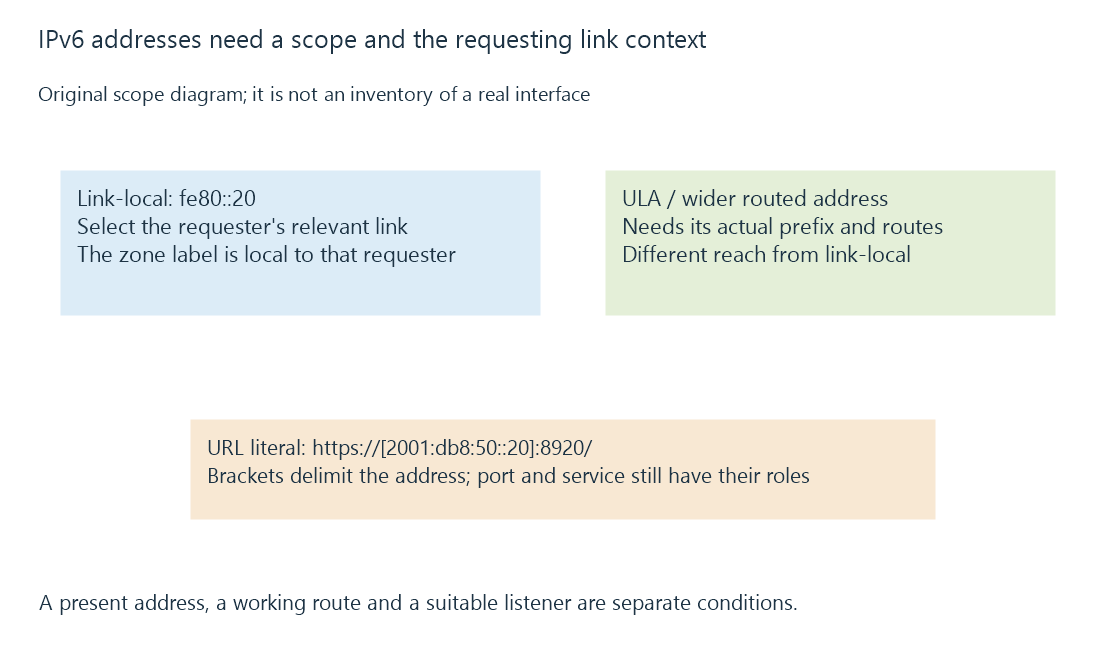
Link-local destinations need a link context
The address fe80::20 can occur on different links. A machine with Ethernet and a VPN therefore needs to know which link is intended when using such a destination.
A zone identifier, often an interface name or local index, supplies that context in supporting interfaces. Its value is local to the requesting machine: one device’s interface number is not a portable global label.
RFC 9844 is the current referenced user-interface specification and obsoletes RFC 6874. Actual browser/app input support still needs to be established by the implementation. A bare link-local address copied from the server is consequently a poor universal endpoint for unrelated remote clients.
The URL has another delimiter requirement
An IPv6 address literal in a URL authority uses brackets so the address’s colons do not become confused with a port separator:
https://[2001:db8:50::20]:8920/
Here 8920 is the explicit service port. The example assumes the chosen service provides HTTPS on that port; the notation does not enable TLS or create a listener.
Hostnames and URLs develops that complete endpoint.
Wider addressing does not choose an access policy
IPv6 can provide routed global addresses without the IPv4 address-sharing translation familiar in many homes. Inbound traffic still depends on routes, gateway policy, host firewall and service binding.
ULA routing can connect selected private sites or VPNs. It does not provide a normal public-internet route merely because its addresses have the IPv6 width.
Neighbor Discovery and router information also have their own roles. IPv6 uses multicast rather than IPv4-style broadcast for many link operations; an application cannot simply reuse an IPv4 broadcast discovery exchange unchanged.
A hostname can offer both families
An A record can supply IPv4 while an AAAA record supplies IPv6. Either family can have a working route, a broken route or a stale endpoint.
A client can try them in a chosen order or use connection concurrency. Having a valid AAAA answer alone does not prove that the matching listener and return path work.
See Also
- IP addresses and reachable interfaces
- Private, public and special-purpose IP addresses
- Hostnames, URLs and the complete server endpoint
- Firewalls, traffic rules and connection state