Cast and crew credits
A credit relates a person or organization to a work through a role, optional character and presentation order, retaining identity beyond the printed name.
A credit is a relationship between a contributor and a work. It can retain a role, a character played and an order used for presentation.
The printed name is a label for that relationship, not necessarily a unique person identifier.
Identity and responsibility occupy different fields
An original credit model could contain:
| Person key | Printed name | Role | Character |
|---|---|---|---|
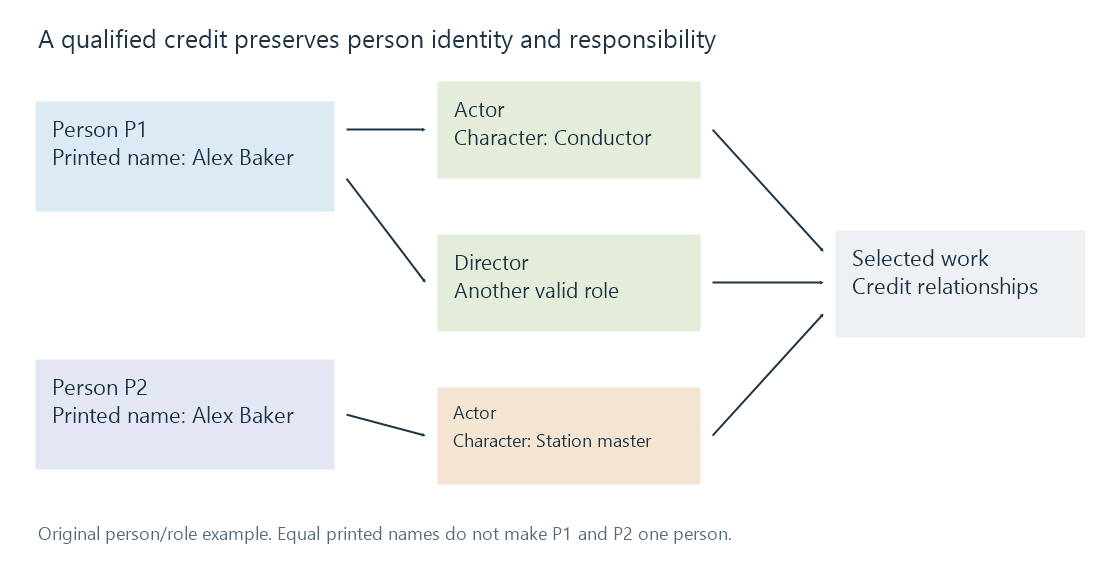
| P1 | Alex Baker | Actor | Conductor |
| P1 | Alex Baker | Director | — |
| P2 | Alex Baker | Actor | Station master |
P1 has two responsibilities. P2 is another invented person who happens to share the same name.
Deduplicating every Alex Baker line loses both distinctions. A more useful key considers the person and the qualified relationship being represented.
A character is another presentation relationship
The actor's name and the character's name serve different purposes. A cast display can show both without treating the character as a separate actor record.
The same performer can also portray several characters. Flattening those descriptions into an arbitrary separator string can make later imports ambiguous.
Multiple-valued fields develops why list boundaries and qualifiers should survive serialization.
Credit order has meaning too
Cast order can reflect a supplied presentation rather than alphabetic ordering or importance inferred by the library. Crew can be grouped by responsibility.
An original ordered sequence of three credits contains more information than an unordered set of their names. Sorting the printed names for convenience changes that sequence.
In Emby, compare the imported people/role information with the selected provider or local record. The pinned NFO parser has actor handling, but recognizing one input form does not imply that every provider credit category maps identically.
Attach the credit to the intended work
A series-level credit, an episode guest appearance and a particular music-video production can describe different scopes. Copying series credits into every episode can imply participation not established by those records.
Metadata relationships explains how directed, qualified links retain that context. A useful correction identifies the contributor, role, work and source instead of changing a printed name until the list looks plausible.