ISDB-T terrestrial television
ISDB-T defines segmented terrestrial transmission with layer/configuration relationships, while regional media profiles and the selected service determine later playback requirements.
ISDB-T uses a segmented terrestrial transmission arrangement. The familiar thirteen-segment structure describes the physical transmission organization, not a count of thirteen TV programmes.
Layers can use different supported configurations. Regional service and media profiles add another part of the receiving/playback relationship.
One central segment can have a separate role
DiBEG describes One-Seg as a partial-reception arrangement using the central segment, with the other twelve available for the broader service arrangement.
Linux’s frontend properties also distinguish layer segment counts and partial reception. Those are implementation parameters, not viewer-facing channel numbers.
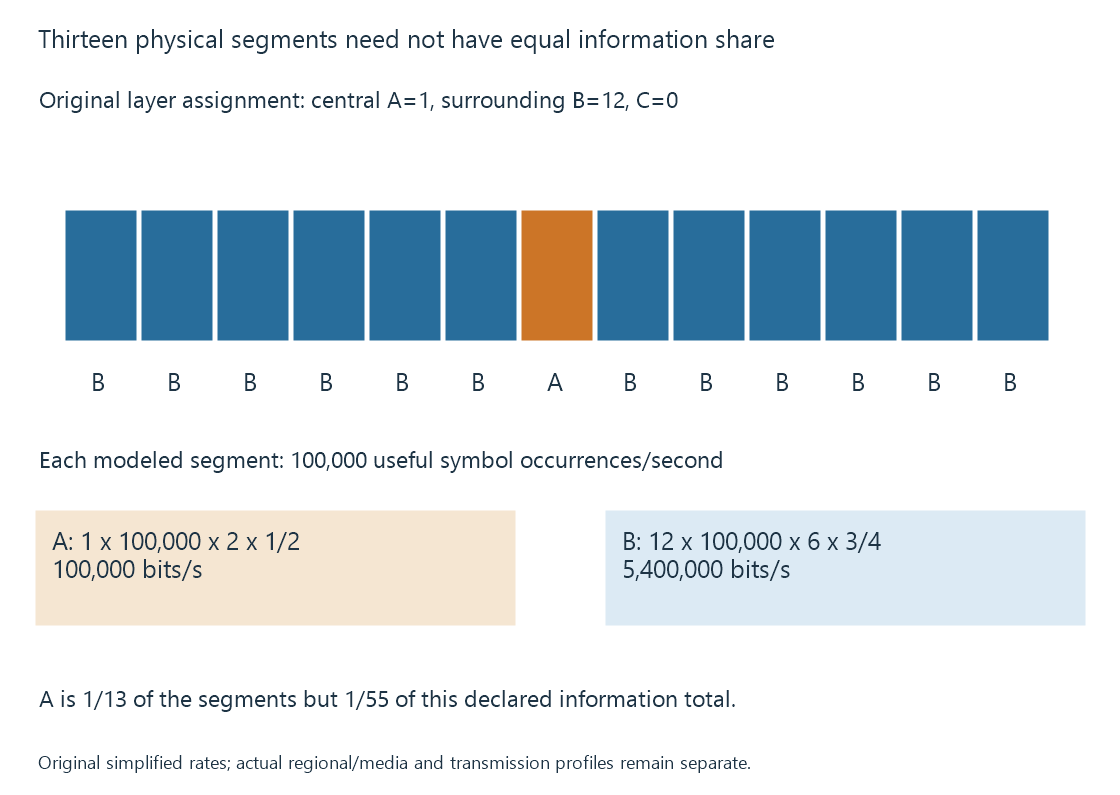
Use an original assignment:
| Model layer | Segments | Declared symbol-label bits | Declared information fraction |
|---|---|---|---|
| A | 1 | 2 | 1/2 |
| B | 12 | 6 | 3/4 |
| C | 0 | — | — |
The segment counts sum to thirteen. The table is an invented configuration exercise, not a broadcaster’s transmitted parameters.
Segment count does not equal information share
Assume each modeled segment contributes 100,000 useful symbol occurrences per second, with other overhead excluded.
The layer ceilings become:
A = 1 × 100,000 × 2 × 1/2 =   100,000 bits/s
B = 12 × 100,000 × 6 × 3/4 = 5,400,000 bits/s
Layer A has one-thirteenth of the segment count but one-fifty-fifth of the modeled information total, about 1.82%.
The difference comes from the declared modulation/coding choices. A real capacity calculation needs the actual symbol arrangement, pilots, guards, coding and other structure.
One-Seg is consequently not a rule that one-thirteenth of every full service’s bitrate becomes available to a partial receiver.
Transmission and regional media profiles differ
ARIB STD-B31 addresses the defined transmission system. DiBEG’s harmonization material distinguishes transmission, media coding and other service requirements across participating regional arrangements.
An ISDB-T RF label should therefore not be expanded into one universal video/audio codec claim for every country and service.
An Emby source has to expose the wanted recovered programme, while the client needs its actual encoded components. Correct layer reception and a supported media decoder are separate conditions.
The selected service still needs identity
The receiver’s physical/layer configuration identifies the acquired data path. Service and component identifiers locate the wanted programme within it.
See Also
- Over-the-air television
- Digital television standards and compatibility layers
- TV signal quality and decoding margin