AMD VCN generation capabilities
AMD VCN capability tables separate codec directions, sample configurations and product-specific engine availability, including exceptions within one named generation.
AMD's VCN tables describe both a media-generation feature set and product-specific availability. Their codec rows need to be read together with the product notes.
A VCN version alone is not a complete encoder or decoder query.
Published codec progression
The pinned AMD AMF reference labels all its displayed codec rows as 4:2:0. Selected AV1 and HEVC entries are:
| Reference group | HEVC decode/encode precision | AV1 decode | AV1 encode |
|---|---|---|---|
| VCN 2.0 | Listed 8/10-bit paths | Not listed | Not listed |
| VCN 3.0 / 3.1 | Listed 8/10-bit paths | Listed 8/10-bit | Not listed |
| VCN 4.0 | Listed 8/10-bit paths | Table lists 8/10/12-bit | Listed 8/10-bit |
| VCN 5.0 | Listed 8/10-bit paths | Table lists 8/10/12-bit | Listed 8/10-bit |
These are the source's grouped declarations. Exact profile/level, dimensions, implementation and product exceptions refine their use.
The kernel's product/IP table can express more specific component revisions than the vendor summary group. Preserve each source's version scope rather than forcing their labels to be identical.
A product note can remove the encoder assumption
The same AMD reference identifies Navi24 RX 63xx/64xx/65xx entries as decode-only, while other VCN 3.0 products have a different arrangement.
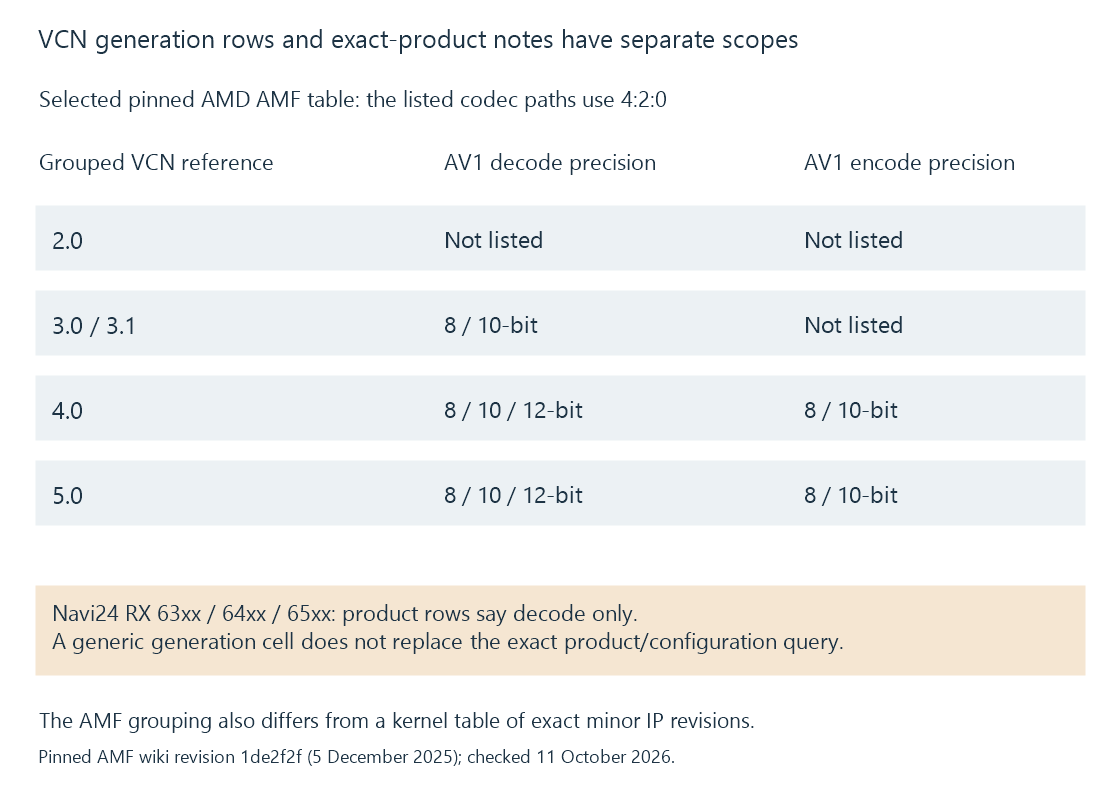
That note means a generation-row encoder declaration should not be copied unconditionally onto those products. Their actual decoding formats also need the exact product/interface evidence.
An Emby conversion requiring new compressed video therefore asks for an available encoder, not merely a VCN label.
Instance count and codec availability are separate
The reference lists different numbers of VCN instances for products. It also states that its AV1 encoder is supported on one VCN instance, except the noted Strix Halo arrangement where both support it.
Two physical instances consequently do not automatically establish two AV1 encoding resources. Codec operation and instance-specific availability remain distinct.
The broader session discussion explains why those hardware resources are also different from a count of sustainable playback clients.
Actual software selects the usable route
AMF or another implemented interface supplies the usable operation, surface representation and driver context. The target encoder and source decoder can require different formats.
For a supported AV1 source-to-H.264 output job, the source needs the appropriate AV1 reconstruction while the target needs H.264 encoding. The filters and picture lifetimes connect those two operations.
See Also
- AMD Video Core Next (VCN)
- AMD Advanced Media Framework (AMF)
- How to read a hardware codec support matrix
- Concurrent encoder sessions, policy and capacity
- Driver-dependent media capabilities