HDCP and protected display links
HDCP authenticates supported display-link participants and protects audiovisual transport under the applicable content and output policy.
HDCP, High-bandwidth Digital Content Protection, addresses protected audiovisual transmission over supported display interfaces. Its participants authenticate under the applicable protocol before protected output is established.
This is a display-link relationship. It is different from decoding the movie’s video codec or choosing an Emby network-delivery method.
The participants have defined roles
| Role | Responsibility in the protected route |
|---|---|
| Transmitter | Sends protected audiovisual output under the implemented protocol |
| Receiver | Authenticates and receives that output |
| Repeater | Participates upstream while maintaining the required downstream protection/topology relationship |
DCP publishes interface-specific HDCP specifications and related material. Protocol revision, interface and device role need to accompany a claim of support.
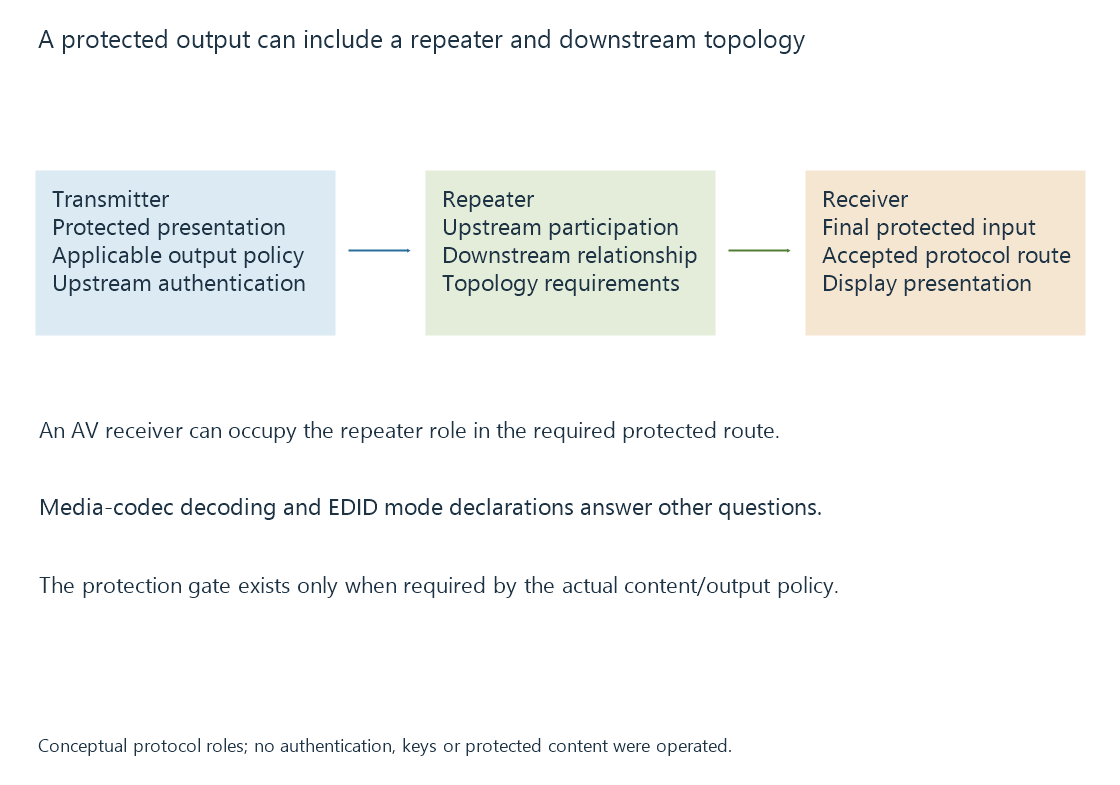
An AV receiver can consequently add more than a video-bandwidth constraint. Its protected upstream and downstream arrangements must be valid for the chosen route.
Authentication is separate from mode declarations
A source can read a display declaration and select an otherwise supported picture mode before another required stage fails.
HDCP is not simply an EDID flag that makes the chosen connection valid. It includes an active protocol relationship, with appropriate participant and topology checks.
If protected presentation is required by the actual content/output policy, a failure can prevent visible output or produce an application-specific error. The symptom alone does not identify the exact stage.
HDMI handshakes separates capability exchange, transport establishment and protected-output progress.
Codec support answers another question
A TV accepting an HDCP-protected HDMI picture signal is not being asked to decode the original movie’s HEVC stream through that input.
The client ordinarily performs media decoding before producing the display signal. Its codec capability and the link’s protected-output capability therefore have different scopes.
A codec error in Emby and an authenticated-display-link error can both interrupt playback while belonging to different parts of the route.
Delivery DRM and output protection can be connected
A protected media system can decrypt/license media within its implemented playback environment and apply an output policy to the resulting presentation. That policy can require a suitable protected display route.
Playback DRM and browser EME describe earlier application/delivery relationships. They do not replace the output-link protocol.
Likewise, the mere existence of HDCP hardware does not establish which policy the current source or application requires.
See Also
- AV receivers in the video path
- HDMI handshakes and black screens
- DRM-protected media and authorized playback paths
- Encrypted Media Extensions (EME) and browser key sessions