Display refresh rate
Display refresh rate describes how often the output refreshes or scans pictures, independently of how often the source contains a new picture.
A refresh rate of sixty hertz describes sixty refresh occurrences per second under that output mode. The interval is the reciprocal of the rate.
It is a display timing property. The source’s frame rate describes when its own pictures occur.
The refresh interval sets a presentation grid
| Declared fixed refresh | One interval |
|---|---|
| 24 Hz | 41.667 ms |
| 50 Hz | 20 ms |
| 60 Hz | 16.667 ms |
| 120 Hz | 8.333 ms |
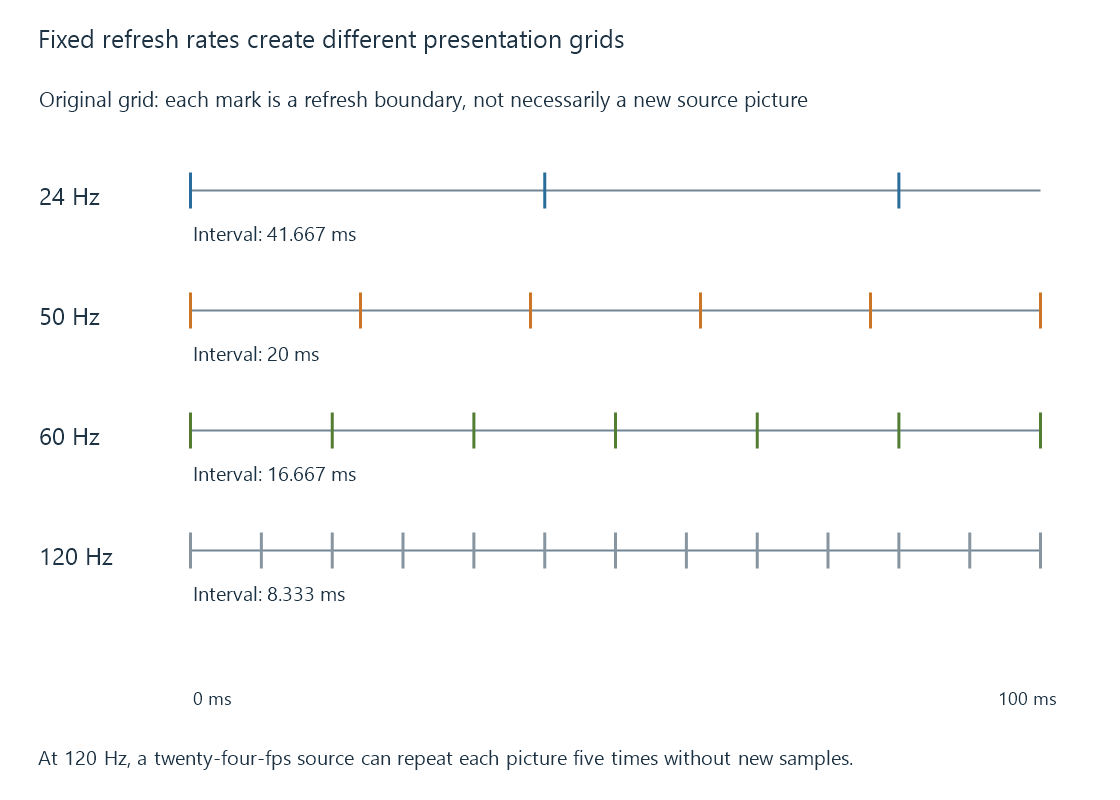
A higher refresh rate provides more presentation opportunities. What is shown at those opportunities depends on the player, source and display processing.
Repeating a picture preserves its source identity
A 24-fps source on an exact 120-Hz presentation grid can hold each source picture for five refreshes. The display refreshes 120 times per second, but the source still supplies twenty-four distinct pictures.
A display using motion interpolation can synthesize intermediate pictures. That is another operation, with an estimate of movement between source samples. It is not implied by selecting a 120-Hz mode.
An interface animation, a game and a movie can therefore use the same output refresh while having different picture-update behavior.
Fractional modes are different clocks
The rate 60000/1001 is approximately 59.940 Hz, not exactly 60. The rate 24000/1001 is approximately 23.976 fps, not exactly 24.
Their ratio is 2.5, so that particular source/output pair needs uneven picture repetition unless another mechanism changes the presentation schedule.
By contrast, 120000/1001 divided by 24000/1001 is exactly five. Rounded labels can hide this useful relationship.
Frame-rate matching develops both integer repetition and small clock mismatches.
Refresh is not pixel response
A refresh can progressively scan rows rather than make the entire panel change at one instant. Pixel transitions then have their own response and illumination timing.
A quoted one-millisecond response does not turn a sixty-Hz output into a thousand-Hz refresh mode. Conversely, a high refresh rate does not guarantee that every pixel transition settles before the next update.
For Emby playback, the selected output mode, source cadence and presentation behavior establish the motion schedule. The display’s response time and persistence determine additional visible properties.
See Also
- Frame-rate matching at the display
- Vertical synchronization (VSync)
- Variable refresh rate (VRR)
- Video Frame Rate