
Leaderboard




Popular Content
Showing content with the highest reputation on 06/22/25 in Posts
-
Thanks! It's working and looks supernice with 7% icon size. In case anyone wants the images, I attached them to the post (incl. hdr10plus in case it's implemented at any time).



 2 points
 -
Android Automotive. Not to be confused with Android Auto. "As compared to Android Auto, Android Automotive is a full operating system that can power the entire experience when driving. It’s installed on the head unit available in the cabin, so it’s in charge of everything from the moment you turn on the engine to the one when you leave the car. -AutoEvolution.com" I have Android Automotive in my Polestar 2. And while its not as popular as Android Auto yet, its pretty impressive. Its gaining more traction too. I hear GMC, Cadillac and many others are using it now too. Emby, please add a compatible app for Android Automotive in the google play store. Are there any plans for this?1 point
-
Here you go, this should be complete unless i f.ed up. EmbyIcons.dll1 point
-
Was only a test version, sorry I should have said that, will give you the right one a little later1 point
-
Thanks, that worked exactly as you described!1 point
-
Try this one, should be no more false positives. I will look into HDR 10+ later, though as always i won't promise anything! EmbyIcons.dll1 point
-
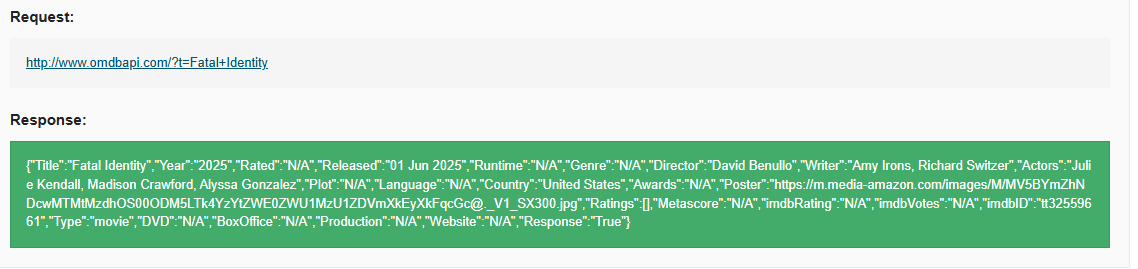
Doesn't appear to exist on TMDB or TVDB yet. You will need to ensure you have OMDB enable on the library for it to fetch what little data they do have. Fatal Identity — The Movie Database (TMDB) Fatal Identity - TheTVDB.com To a point all that exists is Cast/Crew same as shown on IMDB but OMDB will not list all cast. OMDB As mentioned IMDB is never used directly as they want too much to use their api. The id will be queried per your Library metadata order. AWS Marketplace: IMDb Essential Metadata for Movies/TV/OTT (Bulk data) So currently one would have to manually apply info until someone added this to TMDB/TVDB. Watch Fatal Identity (2025) - Free Movies | Tubi
 1 point
 -
Then based on @Monkolf‘s original point, this request should be unflagged as “solved by a plugin”, if that is in fact not the case anymore. My 2C. Mission critical items such as key metadata should really be handled by an official solution, rather than a third party one. No offence to the original plugin author, they did a tremendous job in the absence of one. But the drop in support perfectly illustrates the need for a first party solution. From my experience, I wouldn’t ever trust something, that was not first party developed, to d!ck around in production database. I don’t at work. I sure as hell wouldn’t at home. It’s +1 from me for this feature. There’s not a feature the competition could introduce to match Emby if Emby cracked intro-ship metadata in nfo. It’d be an absolute game changer.1 point
-
14.5 KMEGDT5 channel name "CHSN" is now available in your OTA lineup The other channel is still being considered by Gracenote and needs to be added to their database1 point
-
Was a solution reached?1 point
-
Just popping in to say tested latest v12 with Kodi v22 nightly. All working well. Good stuff. Might be nice if you included the file source URL in the 1st post. Took me a while to work that one out https://kodi.emby.media1 point
-
Items/<ItemId> is not a valid API. You need to use either /Items?Ids=<Id> for partial item response but with support for multiple items at once or /Users/<User>/Items/<Id> for the full item response but with support for only a single item at a time.1 point
-
Hi, one easy way to see what's wrong is to use the browser debugger to monitor what the emby metadata sends for the same operation, and then just match that.1 point
-
I'll pitch in here with my perspective as a software developer and lifelong music listener. Back in 2023 I evaluated Emby and Jellyfin (Docker containers) on my TrueNAS SCALE (now CE) server and an ancient Primate NP5 DLNA device. The NP5's DLNA implementation had some issues which didn't seem to affect Jellyfin but the device would not work with Emby. I was able to borrow a different DLNA device so that I could evaluate both Jellyfin and Emby (and briefly, a few others) over the course of a couple of months. At some point during that time I had to return the borrowed DLNA device and so had to use Jellyfin exclusively for a few weeks. What I found in Emby was a well thought out and consistent and reliable media server and with few, if any, rough edges. Jellyfin in contrast really did feel more amateur,, clearly lagging behind in terms of basic reliability and features. I reported the NP5 issue to the Emby dev team and they were fantastic, building in a workaround to that old and now obsolete device. They didn't have to do that. The result is that Emby has been reliably working in my system since then and I use it every day. I immediately bought a lifetime licence in order to support further development and show gratitude. Open or closed source, free or paid does not define the quality of a software product. There are good and terrible examples of all of those. If someone's value system directs them to use open source software exclusively then that is of course okay but that means nothing about software quaity. Ditto if someone prefers paid software instead of free. What it comes down to is the quality of the product, regardless of whether it's free or paid, open or closed source. For me, Emby wins easily. Jellyfin's popularity is baffling; it's mentioned so often by people when Emby is far superior. Seems like ideology instead of objective analysis is dictating decisions and that is never a good thing.1 point
-
For the ones having trouble adding folders from an ntfs partition, on ubuntu 16.04 / mint 18 you may want to try this: With the Disks utility, on the mounting options, switch the automatic mounting options, and select mount on startup. Then after reboot try adding again the ntfs folder, but keep in mind that it is mounted now on /mnt/ instead of /media/user/ Please note I have no idea why this works.1 point
-
No sorry i diddnt I have just been manually searching with imdb website as i have time. im still looking0 points