Corrupt Database
If your server log file shows SQLite errors like the following example, it is most likely that your library.db file needs attention.
SQLitePCL.pretty.SQLiteException
What can cause this to happen
Typical causes of this are sudden and abrupt terminations of the Emby server process, such as a power loss, operating system crash, force killing the server process, etc. Database errors could also arise if you switch back and forth between Emby Server public release and beta releases.
Important
In general, downgrade from beta to an earlier public release is not supported. Databases may be incompatible.
The following logged database error indicates a corrupt database file:
SQLitePCL.pretty.SQLiteException: Corrupt: database disk image is malformed
SQLite tools can be used to try and recover from this. Alternatively, an easier option would be to see if you can restore the database from a backup - refer to Backup & Restore for details of how to restore the databases from a backup.
Tip
You should always check first, if restore from a backup, resolves the issue before attempting database repairs using the SQLite tools.
Attempt to recover the database
Identify the corrupt database
Emby Server has 4 databases: activitylog.db, authentication.db, library.db and users.db. The main database is the library.db which tends to be the one that may end up with a corruption.
There would be clues in the embyserver log file as to which database is corrupt. The following maps the internal database names to the actual database filenames:
| SqliteItemRepository | library.db |
| SqliteUserRepository | users.db |
| AuthenticationRepository | authentication.db |
| ActivityRepository | activitylog.db |
As an example, the following log line within the logged error block indicates that the corrupt database is the library.db:
at Emby.Server.Implementations.Data.SqliteItemRepository.Initialize
Find Location of Database Files
If the Emby Server is not launching due to the corruption, please refer to Server-Data-Folder for establishing where the Emby Server data is stored. The database files are in the "data" sub-directory below the path shown in the support document.
Alternatively, you can find the path by using the "..." top menu right above the server information box in the Emby Server Settings Dashboard.
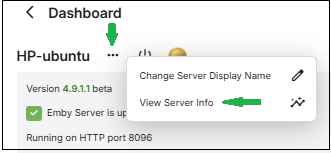
Click on View Server Info.
The database files are in the "data" sub-directory below the Program data path shown.
You will need to use a command-line window, linux shell window, mac terminal session to run the command line shell for SQLite. For NAS, an ssh connection would be needed to access the database files. For Android, adb would be needed.
The examples below, will all be for the library.db.
Solutions to Try in This Order
Remove Database Locks
Shutdown Emby Server if it is running and check that the EmbyServer process is no longer showing before proceeding to the next step. Check with Windows Task Manager, macOS Activity Monitor, top or "ps -aux | grep emby" on linux and NAS.
In a command line window or terminal session on macOS, or shell window on linux and NAS, navigate to the
datadirectory containing your database file. The following are a few examples, refer to the Server Data Folder document for the complete list.
On some NAS systems, you may need to gain root privileges first by executing "sudo -s" first.
Examples:
Windows
cd "%AppData%\Emby-Server\programdata\data"
Linux
cd /var/lib/emby/data
macOS
cd ~/.config/emby-server/data
or
cd ~/emby-server/data
Western Digital NAS
cd /mnt/HD/HD_a2/emby/data
Synology DSM 7 NAS
cd /volume1/@appdata/EmbyServer/data
Synology DSM 6 NAS
cd /volume1/Emby/data
QNAP NAS
cd /share/CACHEDEV1_DATA/.qpkg/EmbyServer/programdata/data
or
cd /share/HDA_DATA/.qpkg/EmbyServer/programdata/data
(see Server Data Folder for the paths for other platforms)
- Delete the
library.db-shm&library.db-walfiles if present. You can check if they are present usingdiron windows orlson other platforms.
Windows
   del library.db-shm
   del library.db-wal
Other platforms
You may need to gain root privileges by executing "sudo -s" first.
   rm library.db-shm
   rm library.db-wal
- Restart Emby Server
Check your server log for SQLite errors and only continue to the next step if needed.
Check Database Integrity and Recover Database
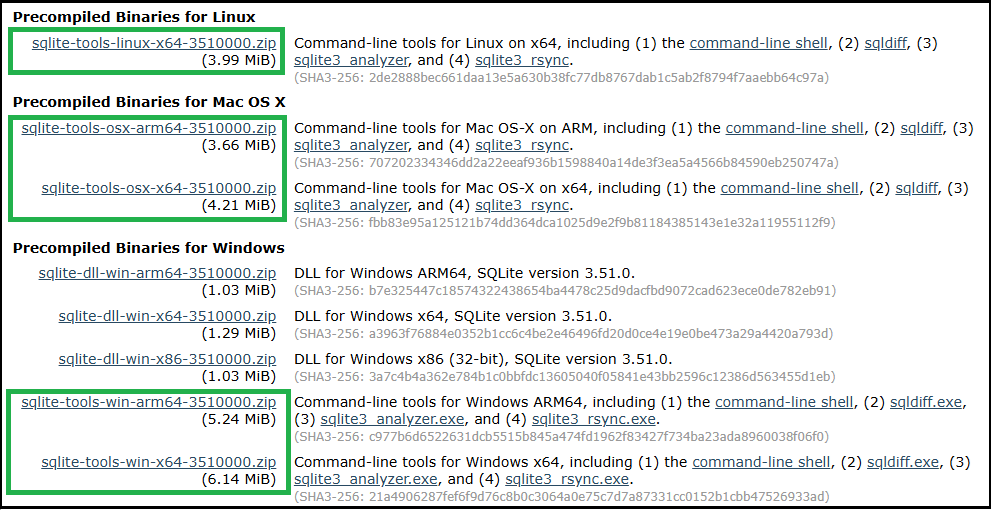
This step will require the use of the Command line shell for SQLite3 tool, which may be pre-installed on some platforms. It can be downlaoded as part of the Sqlite3 tools from https://www.sqlite.org/download.html. If you prefer a graphical based editor, you can download DB Browser for SQLite which is available for most platforms. The instructions given in this document are for the official SQLite3 tools provided by https://sqlite.org.
Note
On NAS platforms and for Android Emby Server, you may need to copy the database file to a computer and do the integrity check and repair on the computer and then copy the file back. Access to the database on NAS systems will require enabling & using ssh, and adb & enabling Developer Options for Android.
The following shows the available sqlite tools binaries for download:
Note
On some NAS platforms, you may need to gain "root" privileges by executing "sudo -s" first. Alternatively, prefix commands with "sudo". For some platforms, you would be using root and there is no "sudo" command.
Run Integrity Check
Shutdown Emby Server if it is running and check that the EmbyServer process is no longer showing before proceeding to the next step. Check with Windows Task Manager, macOS Activity Monitor, top or "ps -aux | grep emby" on linux.
Navigate to the folder containing your database file, see earlier paragraph covering this.
If you downloaded the sqlite3 tools rather than using a pre-installed sqlite3 binary, copy the downloaded sqlite3 file (sqlite3.exe or sqlite3) to this directory to make it easier to use. Alternatively, create a temporary folder where you place the database file you are working on and the sqlite3 tool.
Important
Check that you are in the right directory, the directory where the database file is, as sqlite3 does not warn you if it it does not find the database and would instead create a new database in the current path.
Open the library.db database and run an integrity check on it:
sqlite3 library.db
PRAGMA integrity_check;
This should return an "ok" when there are no corruptions. If errors are reported, we need to repair the database.
type in .quit to exit
Examples of results:
Corruption detected
SQLite version 3.50.1 2025-06-06 14:52:32
Enter ".help" for usage hints.
sqlite> PRAGMA integrity_check;
Parse error: database disk image is malformed (11)
sqlite> .quit
Successful integrity check
SQLite version 3.50.1 2025-06-06 14:52:32
Enter ".help" for usage hints.
sqlite> PRAGMA integrity_check;
ok
sqlite>.quit
Repairing the database
With Emby Server shutdown, save a copy of the existing database file and then work on the actual database file.
Windows
copy library.db library-saved.db
Other Platforms
cp library.db library-saved.db
Attempt to vacuum and reindex the database to see if that resolves the issue. Switch to the directory holding the database and open it and run the two commands:
sqlite3 library.db
VACUUM;
REINDEX;
The commands may take a while to complete. You may get errors indicating corruption.
At the end, close the database and exit, with the .quit command.
If there were no errors, then you can try to see if the issue is resolved.
Restart Emby Server and check the emby logs for database errors.
If database errors persist or the VACUUM or REINDEX failed, then we can try to run the .recover SQLite3 command.
Shutdown Emby Server
Navigate to the databases folder as before and open the database file with sqlite3:
sqlite3 library.db
.output recovered-librarydb.sql
.recover
This may take a while to run. At the end, type .quit to close the database file.
The recovered-librarydb.sqlfile will contain the sqlite3 commands to recover the database. The file may be large but it is a text file, and you should be able to view its contents - using text editors that can handle potentially very large files.
We can now create a new database file using this recovery file.
Create a new database file and lets call it library-recovered.db. The following creates this new db file:
sqlite3 library-recovered.db
.read recovered-librarydb.sql
(this may take a while to run, so please wait for it to finish)
Enter .quit command to close the database and exit.
We will now check the integrity of our recovered database by running:
sqlite3 library-recovered.db
PRAGMA integrity_check;
This should return an integrity_check back of "ok" with no errors reported. If errors are returned, please report this in the forum before proceeding to Reset the Library Database. If "ok" and no errors are reported, continue with the next step.
At this point, we have
library-saved.db        Original corrupt/suspect database
library.db              Original corrupt/suspect database
library-recovered.db    The new repaired database
We will now rename the library.db to library.db.old and switch the new repaired database to be the library.db.
Windows
rename library.db library.db.old
rename library-recovered.db library.db
Other platforms
mv library.db library.db.old
mv library-recovered.db library.db
If this is for a NAS and is being repaired on a computer, we now need to copy the new repaired library.db to the NAS databases directory.
Similarly, if the repair was done working in a temporary directory, we need now to copy the new repaired library.db to the correct directory overwriting the corrupt/suspect database file.
Ensure the new library.db has the same permissions and ownership as the original library. Adjust the permissions and ownership if not. For linux and NAS, the owner, group and permissions can be seen for files in the data directory by executing ls -ail.
Restart Emby Server
Check you server log for SQLite errors and only continue to the next step if the database still gives errors and the repair has not been successful.
Steps to Reset Library Database & Start with a Fresh new setup of Emby Server
Shutdown Emby Server
Navigate to the databases folder as per the earlier instructions
Rename library.db to library.db.corrupt
Windows
rename library.db library.db.corrupt
Other platforms
mv library.db library.db.corrupt
Restart Emby Server
Recreate your media libraries